
Introduction
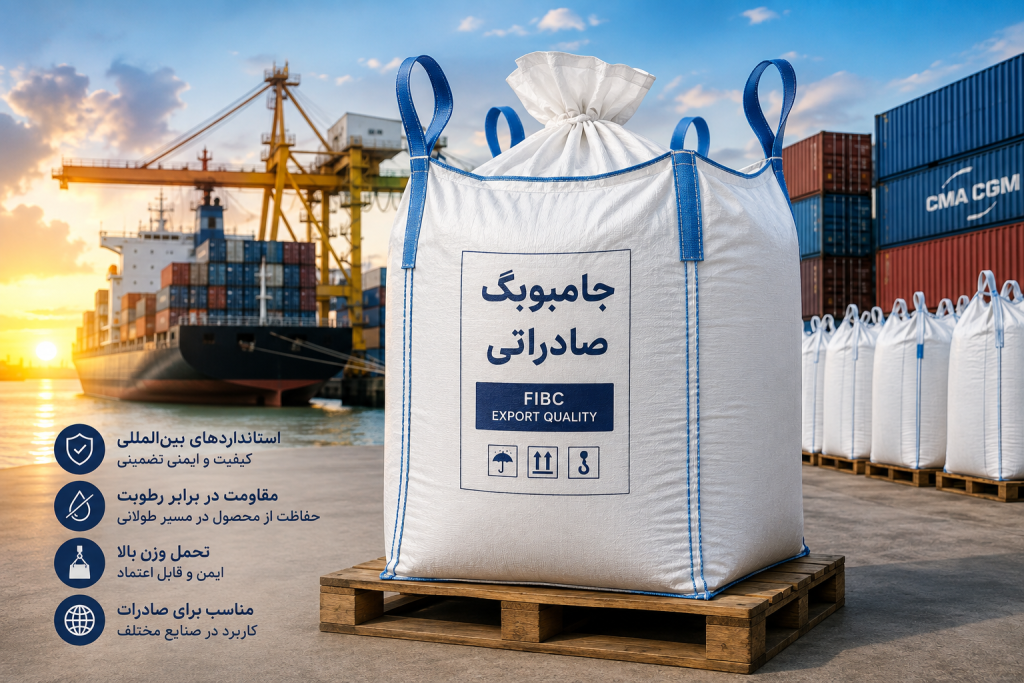
Export Jumbo Bags, also known as FIBC Bags, Bulk Bags, Big Bags, or Flexible Intermediate Bulk Containers, are widely used for packaging, storing, handling, and transporting bulk materials in international trade.
Unlike a standard industrial Jumbo Bag, an export FIBC must be selected according to the specific requirements of the product, transportation method, destination country, storage conditions, and loading and discharge systems.
Factors such as Safe Working Load (SWL), Safety Factor, bag dimensions, fabric GSM, lamination, inner liner, filling and discharge systems, electrostatic properties, and applicable standards can all affect the performance of a Jumbo Bag during international transportation.
For non-dangerous solid materials, ISO 21898:2024 specifies requirements related to the materials, construction, design, type tests, and marking of FIBCs, as well as guidance for their safe selection and use.
In this guide, we will explain what an Export Jumbo Bag is, how it differs from a standard FIBC, which specifications are important, and how to select the right Jumbo Bag for international shipping.
What Is an Export Jumbo Bag?
An Export Jumbo Bag is a type of Flexible Intermediate Bulk Container (FIBC) designed and manufactured for transporting bulk materials through international supply chains.
Most FIBCs are manufactured from woven polypropylene (PP) and can be customized according to the characteristics of the product and the requirements of the transportation process.
Export Jumbo Bags are commonly used for products such as:
- Petrochemical products
- Plastic granules
- Minerals
- Agricultural products
- Fertilizers
- Chemicals
- Industrial powders
- Food ingredients
- Cement and construction materials
- Industrial raw materials
The main difference between a standard industrial Jumbo Bag and an export-oriented FIBC is the need to consider the entire international logistics chain.
The bag may be filled at the manufacturer’s facility, lifted by handling equipment, loaded into a shipping container, transported by sea or land, unloaded, stored, and finally discharged at the destination.
For a broader overview of Jumbo Bag construction, types, applications, manufacturing, and specifications, see the Complete Jumbo Bag (FIBC) Guide.
Why Is Choosing the Right Jumbo Bag Important for Export?
International shipments can remain in transit for days or weeks and may be exposed to different handling and environmental conditions.
During transportation, an Export Jumbo Bag may be:
- Lifted by forklifts
- Loaded into shipping containers
- Stacked
- Transported over long distances
- Exposed to temperature variations
- Exposed to humidity
- Handled several times
An unsuitable FIBC design may result in:
- Fabric tearing
- Product leakage
- Moisture penetration
- Bag deformation
- Difficult discharge
- Product loss
Therefore, an Export Jumbo Bag should be selected according to its actual application and transportation conditions, rather than price or appearance alone.
Important Export Jumbo Bag Specifications
1. Safe Working Load (SWL)
One of the first specifications to determine is the Safe Working Load (SWL).
Common FIBC capacities include:
- 500 kg
- 750 kg
- 1,000 kg
- 1,250 kg
- 1,500 kg
- 2,000 kg
However, capacity should not be selected based solely on the weight of the product.
Other factors include:
- Bulk density
- Product volume
- Filling method
- Discharge method
- Transportation conditions
Two products with the same weight may therefore require different Jumbo Bag dimensions.
2. Export Jumbo Bag Dimensions
FIBC dimensions should be determined according to:
- Product weight
- Bulk density
- Product volume
- Container dimensions
- Stacking requirements
- Filling equipment
- Discharge equipment
Incorrect dimensions can result in inefficient use of container space and potentially increase transportation costs.
For this reason, FIBC dimensions should ideally be determined as part of the export logistics planning process.
3. Jumbo Bag Fabric Type
Most FIBCs are manufactured from woven polypropylene fabric.
Fabric weight, commonly expressed as GSM (grams per square meter), is one factor affecting bag performance.
However, higher GSM does not automatically mean that a Jumbo Bag is better.
Fabric specifications should be selected according to:
- SWL
- Product characteristics
- Bag construction
- Safety requirements
- Handling conditions
- Transportation conditions
The objective is to achieve an appropriate balance between strength, weight, cost, and performance.
4. Laminated Jumbo Bags for Export
For products that are sensitive to moisture, a laminated Jumbo Bag can be an appropriate option.
In a laminated FIBC, an additional polypropylene coating is applied to the woven fabric.
Potential advantages include:
- Reduced moisture penetration
- Better containment of fine particles
- Improved product protection
- Better printing surface
However, laminated fabric should not automatically be considered equivalent to a completely waterproof packaging system.
The overall design also matters, including:
- Seams
- Top construction
- Bottom construction
- Filling spout
- Discharge spout
- Inner liner
5. Inner Liner for Export FIBCs
Some export products require or benefit from an inner liner.
FIBC liners are commonly manufactured from materials such as polyethylene and are installed inside the Jumbo Bag.
They may help with:
- Moisture protection
- Contamination control
- Fine powder containment
- Product protection
The liner design should be selected according to the characteristics of the product and the transportation environment.
Types of Export Jumbo Bags
U-Panel Jumbo Bags
U-Panel FIBCs are widely used in industrial and bulk material applications.
Their construction can provide an effective load distribution and can be customized for various export applications.
Four-Panel Jumbo Bags
A Four-Panel FIBC is manufactured from separate fabric panels that are sewn together.
This construction can provide a relatively uniform shape, which may be beneficial for:
- Storage
- Stacking
- Container loading
- International transportation
Baffle Jumbo Bags
Baffle FIBCs incorporate internal baffles that help limit the expansion of the bag after filling.
This can produce a more stable and cube-like shape.
One of the main advantages is potentially more efficient use of available container and warehouse space.
Top Filling Options for Export Jumbo Bags
The top construction should be selected according to the filling process.
Open Top
A simple design suitable for applications where straightforward filling is required.
Filling Spout
Provides more controlled filling and can help reduce the dispersion of fine materials.
Duffle Top
Provides additional coverage around the upper part of the bag and can be useful when greater product protection is required.
The filling system should be compatible with the exporter’s filling equipment.
Bottom Discharge Systems
The bottom of the FIBC should also be selected according to the customer’s discharge system.
Flat Bottom
A simple bottom construction suitable for certain applications.
Discharge Spout
Allows controlled discharge of the bulk material.
Safety Discharge
Some designs incorporate additional features for greater control during the discharge process.
If the importer uses automated discharge equipment, the dimensions and design of the discharge spout should be specified before production.
What Products Are Exported in Jumbo Bags?
FIBCs are used across many industries because of their flexibility and customizable design.
Petrochemical Industry
Export Jumbo Bags can be used for:
- Polyethylene granules
- Polypropylene granules
- Additives
- Plastic raw materials
Mining and Mineral Industries
Applications include:
- Mineral powders
- Processed minerals
- Industrial raw materials
- Certain bulk aggregates
Agricultural Industry
Jumbo Bags can be used for:
- Fertilizers
- Seeds
- Dried agricultural products
- Agricultural raw materials
Food Industry
When an appropriate food-contact design and manufacturing process are used, FIBCs can be used for products such as:
- Sugar
- Flour
- Starch
- Rice
- Food ingredients
Food-grade requirements should always be verified before using a Jumbo Bag for food products.
Export Jumbo Bag Standards
Export FIBCs should not be purchased simply because a supplier claims that a product is “standard.”
Buyers should identify the specific:
- Standard
- Testing requirements
- Material requirements
- Design requirements
- Marking requirements
- Safety requirements
For non-dangerous solid materials, ISO 21898:2024 is an important standard covering materials, construction, design, type testing, marking, and safe selection and use of FIBCs.
The applicable standard should always be determined according to the product and destination market.
UN Certified Jumbo Bags for Dangerous Goods
If the product being exported is classified as dangerous goods, packaging requirements can be significantly different.
Depending on the material classification and applicable transportation regulations, a UN-certified FIBC may be required.
Before selecting an FIBC for dangerous goods, exporters should:
- Identify the product classification.
- Determine the applicable UN number, where applicable.
- Identify transportation requirements.
- Determine the required packaging specification.
- Select an appropriate FIBC design.
- Verify required testing and certification.
A standard industrial Jumbo Bag should not be used for dangerous goods simply because it has sufficient load capacity.
Safety Factor in Export Jumbo Bags
The Safety Factor (SF) is one of the most important technical characteristics of an FIBC.
When specifying an Export Jumbo Bag, buyers should identify:
- Safe Working Load (SWL)
- Safety Factor
- Single Trip or Multi Trip classification
- Required testing
- Applicable design specifications
The safety of an FIBC cannot be determined simply by looking at fabric thickness or the appearance of the finished bag.
Single Trip vs. Multi Trip Jumbo Bags
Single Trip FIBC
A Single Trip FIBC is designed for a specified single-use application and can be suitable for many one-way export shipments.
Multi Trip FIBC
A Multi Trip FIBC is designed for repeated use according to its specified requirements.
However, a Multi Trip designation does not mean that the bag can automatically be reused indefinitely.
The condition, design, and applicable safety requirements should be evaluated before reuse.
Important Tips for Loading Export Jumbo Bags into Containers
Container loading is an important stage of international FIBC transportation.
Consider the following:
Container Space
Jumbo Bag dimensions should be compatible with the internal dimensions of the shipping container.
Total Weight
The total shipment weight must remain within applicable transportation and container limits.
Stacking
Bags should be arranged to minimize movement and damage during transportation.
Moisture Protection
Sensitive products may require additional moisture-control measures.
Mechanical Protection
Avoid:
- Sharp edges
- Dragging bags across floors
- Improper lifting
- Inappropriate handling equipment
These can damage the woven fabric and lifting components.
How to Choose the Right Export Jumbo Bag
Before ordering an Export FIBC, prepare the following information.
Product Information
- Product name
- Product weight
- Bulk density
- Powder or granule
- Moisture sensitivity
- Contamination sensitivity
- Hazardous or non-hazardous classification
Transportation Information
- Destination country
- Transportation method
- Sea, road, or rail transportation
- Container type
- Expected transportation duration
Discharge Information
- Manual discharge
- Machine discharge
- Spout discharge
- Automated discharge system
FIBC Specifications
- Capacity
- Dimensions
- Fabric type
- GSM
- Lamination
- Inner liner
- Lifting loops
- Filling inlet
- Discharge outlet
- Safety Factor
The more accurate this information is, the easier it becomes to manufacture an FIBC that actually matches the export application.
What Factors Affect Export Jumbo Bag Prices?
There is no single fixed price for all Export Jumbo Bags.
The price can depend on:
- Polypropylene resin price
- Fabric weight
- Bag dimensions
- SWL
- Construction type
- Lifting loop design
- Lamination
- Inner liner
- Filling inlet
- Discharge outlet
- Printing
- UV stabilization
- Safety Factor
- UN certification, where required
- Order quantity
Therefore, comparing two FIBC prices without comparing their technical specifications can lead to an inaccurate purchasing decision.
The cheapest Jumbo Bag is not necessarily the most economical choice for export.
Export Jumbo Bag vs. Standard Jumbo Bag
| Feature | Standard Jumbo Bag | Export Jumbo Bag |
|---|---|---|
| Main use | Domestic and industrial applications | International transportation |
| Design | Standard or customized | Designed for export conditions |
| Documentation | May be limited | More important |
| Moisture protection | Application-dependent | Often more important |
| Inner liner | Optional | Based on product requirements |
| Container transportation | Not always the main consideration | Major consideration |
| Destination requirements | Usually limited | Very important |
| International logistics | Less critical | Critical |
Common Mistakes When Buying Export Jumbo Bags
Choosing Based Only on Price
A low-priced FIBC may not provide the required performance for international transportation.
Ignoring Destination Requirements
Different markets may have specific packaging, labeling, or product requirements.
Ignoring Moisture
Moisture can damage or degrade certain products during long-distance transportation.
Choosing the Wrong Dimensions
Incorrect dimensions can reduce container utilization and increase shipping costs.
Using a Standard FIBC for Sensitive Products
Certain products may require:
- Inner liners
- Lamination
- Special construction
- Static-control properties
Ignoring the Customer’s Discharge System
A discharge outlet that does not match the customer’s equipment can cause operational problems at the destination.
Export Jumbo Bag Ordering Checklist
Before confirming an order, make sure you have specified:
- ✓ Product type
- ✓ Product weight
- ✓ Bulk density
- ✓ Required SWL
- ✓ Jumbo Bag dimensions
- ✓ Fabric type
- ✓ GSM
- ✓ Lamination requirement
- ✓ Inner liner requirement
- ✓ Filling inlet
- ✓ Discharge outlet
- ✓ Safety Factor
- ✓ Single Trip or Multi Trip
- ✓ Transportation method
- ✓ Destination country
- ✓ Container type
- ✓ Applicable standards
- ✓ UN requirements, where applicable
Conclusion
Export Jumbo Bags (FIBC) are an important packaging solution for transporting bulk materials through international supply chains. However, selecting the right FIBC should involve much more than comparing price and capacity.
The bag should be selected according to:
- Product characteristics
- Weight
- Bulk density
- SWL
- Dimensions
- Fabric construction
- Lamination
- Inner liner
- Filling method
- Discharge method
- Transportation conditions
- Container type
- Destination requirements
- Applicable standards
- Safety requirements
For non-dangerous materials, ISO 21898:2024 is an important reference for FIBC materials, construction, design, type testing, marking, and safe selection and use. Dangerous goods require additional evaluation of applicable transportation and packaging regulations, including UN requirements where applicable.
Ultimately, the best Export Jumbo Bag is not necessarily the cheapest or most expensive option. It is the FIBC that is correctly designed for the product, transportation route, handling process, and requirements of the destination market.
Frequently Asked Questions About Export Jumbo Bags
What is an Export Jumbo Bag?
An Export Jumbo Bag is an FIBC designed for international transportation of bulk materials while taking into account the product characteristics, handling requirements, transportation conditions, and destination-market requirements.
What is the capacity of an Export Jumbo Bag?
FIBC capacity varies according to design and application. Capacities such as 500, 1,000, 1,500, and 2,000 kg are commonly used, but the appropriate SWL should be determined based on the product and bag design.
Does an Export Jumbo Bag need UN certification?
Not necessarily. UN certification requirements depend on the classification of the product and applicable dangerous-goods transportation regulations. If the material is classified as dangerous goods, the relevant packaging requirements must be verified.
Are laminated Jumbo Bags suitable for export?
Laminated FIBCs can be suitable for products that require additional protection against moisture or fine-particle leakage. However, the appropriate construction should be selected based on the product and transportation conditions.
Can Export Jumbo Bags be reused?
Some FIBCs are designed for multiple trips. Reuse should only be considered when the bag is specifically designed for repeated use and its condition and safety requirements have been properly evaluated.
How do I choose the best Export Jumbo Bag?
Start by identifying the product, weight, bulk density, moisture sensitivity, transportation method, discharge system, destination country, and applicable requirements. Then select an FIBC design that matches those specifications.