jumbobag

all aspects of jumbo bags
Jumbo Bag or Big Bag / FIBC is one of the most important and widely used industrial packaging tools in the world. These large and durable bags are designed for transporting and storing powder, granular, and bulky materials. Due to their high capacity, exceptional strength, and cost-effectiveness, they have become an ideal solution for the mining, petrochemical, food, and agricultural industries.
With the growth of export industries and industrial projects in Iran and globally, the use of jumbo bags has increased significantly. Industrial jumbo bags, thanks to their customizability, resistance to moisture and UV exposure, and branding options, have become a global standard in industrial packaging.
This article provides a comprehensive guide to jumbo bags, covering:
Definition and types of jumbo bags
Structure and components of industrial bags
Safety grades and standards
Applications across various industries
Advantages over traditional packaging
Fabric and raw materials
Manufacturing process, loading and discharge methods
Buying tips, pricing, maintenance, and printing
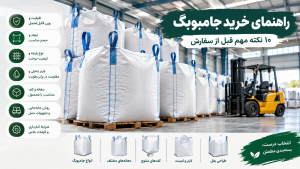
- What is a Jumbo Bag?
A Jumbo Bag (Big Bag / FIBC) refers to large, flexible bags made from woven polypropylene fibers. These bags typically have a capacity ranging from 500 to 2500 kg and are widely used across industries due to their high strength, lightweight design, and customizability.
Key features of jumbo bags:
High resistance to heavy loads, tearing, and pressure
Resistance to impact and moisture
Reusable and cost-effective
Branding and product information printing options
Applications of jumbo bags include:
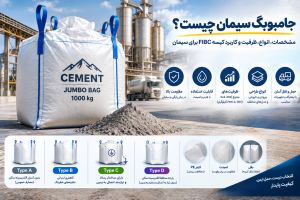
Mining industry: silica, cement, gypsum, barite
Petrochemical industry: resin, polymer, granules
Food industry: flour, sugar, legumes, starch
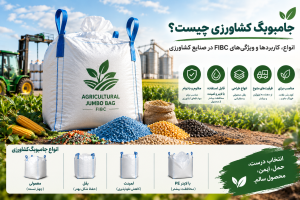
Agriculture: fertilizers, seeds, animal feed
Sea and land exports: ideal for transporting goods internationally
Main advantage over traditional packaging: cost savings, waste reduction, and enhanced safety.
- Structure and Components of Jumbo Bags
Each jumbo bag consists of the following components:
- Body Fabric:
Woven polypropylene fabric with a weight of 140–260 g/m²
Resistant to tearing, moisture, and UV exposure
- Lifting Loops:
For handling with forklifts, cranes, and top lifts
Reinforced for heavy loads
- Filling Spout:
Funnel, double spout, top scarf, or open top
Designed for material entry
- Discharge Spout:
Funnel bottom, open bottom, flat bottom
Allows fast and controlled material discharge
- Baffles:
Internal panels to maintain bag shape
Suitable for 20 and 40-foot containers
- Liner:
Prevents moisture, air, and dust penetration
Types include: shrink, tubular, gusseted, form-fit, acid-resistant
- Types of Jumbo Bags
4.1 Based on Sewing Structure
U-Panel: Three-piece, most common
4-Panel: Four-piece, suitable for heavy loads
Circular Bag: Single-piece, seamless
Baffle Bag: With internal panels, ideal for container use
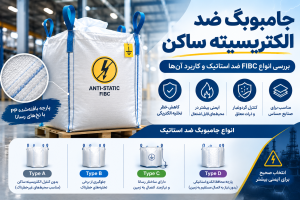
4.2 Based on Electrical Class
Type A: No protection against static electricity
Type B: Resistant to spark discharge
Type C: Anti-static with grounding required
Type D: Anti-static without grounding
4.3 Based on Industrial Application
Food-grade jumbo bags
Mineral jumbo bags
Chemical jumbo bags
Hazardous material jumbo bags (UN Bag)
Agricultural jumbo bags
Export jumbo bags
UV-resistant jumbo bags
- Safety Grades and Load Capacity
Jumbo bags are classified by Safety Factor into three main groups:
Safety Type Factor Application
5:1 Single-use Minerals, construction materials
6:1 Reusable Food industry, exports
8:1 Heavy-duty Hazardous chemicals
Standard load capacities: 500 kg, 1000 kg, 1500 kg, 2000 kg, 2500 kg (Heavy Duty)
- Applications in Various Industries
6.1 Mining Industry
Silica, cement, gypsum, barite
Lead, zinc, copper
Stone powder and calcium carbonate
6.2 Petrochemical Industry
Polymer, resin, granules, masterbatch
6.3 Food Industry
Sugar, flour, starch
Legumes, rice
Bulk food products
6.4 Agriculture
Chemical fertilizers
Seeds
Animal feed
6.5 International Export
Iraq, Oman, UAE, Qatar, Turkey, Azerbaijan
Jumbo bags are the best solution for sea and land transport
- Advantages Over Traditional Packaging
Using jumbo bags offers numerous benefits:
Reduces packaging costs by 30–50%
Occupies less warehouse space
Faster handling with forklifts or cranes
Minimizes material waste
Reusable multiple times
Lightweight with high capacity
Branding and product information printing possible
High resistance to moisture and UV
- Fabric and Raw Materials
Jumbo bag fabric is made from woven polypropylene (PP Woven Fabric), reinforced with:
UV Stabilizer: Resistance to sunlight
Anti-static Additive: Prevents sparks and static
Color Masterbatch: For coloring and logo printing
Slip Agent: Improves material handling
8.1 Fabric Types
Laminated
Non-laminated
Moisture and dust resistant
UV resistant
- Manufacturing Process
The standard jumbo bag production includes:
- Extruding polypropylene fibers
- Weaving the fabric industrially
- Laminating or leaving non-laminated
- Cutting and industrial sewing
- Attaching lifting loops
- Installing liner (if needed)
- Tension and load testing
- Packaging and shipping
- Loading and Discharge Methods
10.1 Handling and Loading
Forklift: Fast, suitable for loads up to 2500 kg
Crane: For bulky and export bags
Top Lift: Using upper loops
Industrial Hook: For limited loading
10.2 Discharge Methods
Filling/Discharge Spout: Fast powder and granule discharge
Open Bottom: For bulk and loose materials
Flat Bottom: Gradual and controlled discharge
Controlled Discharge: For sensitive or export materials
- Buying Tips
When ordering or buying a jumbo bag, consider:
- Product Type: Powder, granular, fine, hazardous, or food
- Load Capacity: 500–2500 kg
- Handling Method: Forklift, crane, container
- Discharge Type: Funnel or flat bottom
- Liner: Essential for food and chemical materials
- UV Protection: Required for outdoor storage
- Printing and Branding: Logo, contact info, tracking code, corporate colors
- Pricing Factors
Jumbo bag prices depend on:
Fabric weight
Sewing type and model (U-Panel, 4-Panel, Baffle)
Lifting loops type
Liner or no liner
UV resistance
Safety class (5:1, 6:1, 8:1)
Current polypropylene material prices
Order quantity and volume
- Maintenance and Lifespan
To increase jumbo bag life:
Store away from direct sunlight
Avoid dragging over rough surfaces
Use pallets under bags
Prevent moisture and overloading
Keep spouts closed during loading
- Printing and Branding
Professional printing enhances brand recognition and export standards:
Flexographic Printing (1–4 colors)
Print logos, contact info
Safety warnings and loading instructions
Guidelines for safe discharge
- Conclusion
Jumbo Bag or Big Bag / FIBC is one of the most cost-effective, durable, and practical industrial bags, widely used in mining, food, petrochemical, agricultural industries, and exports.
Related content