
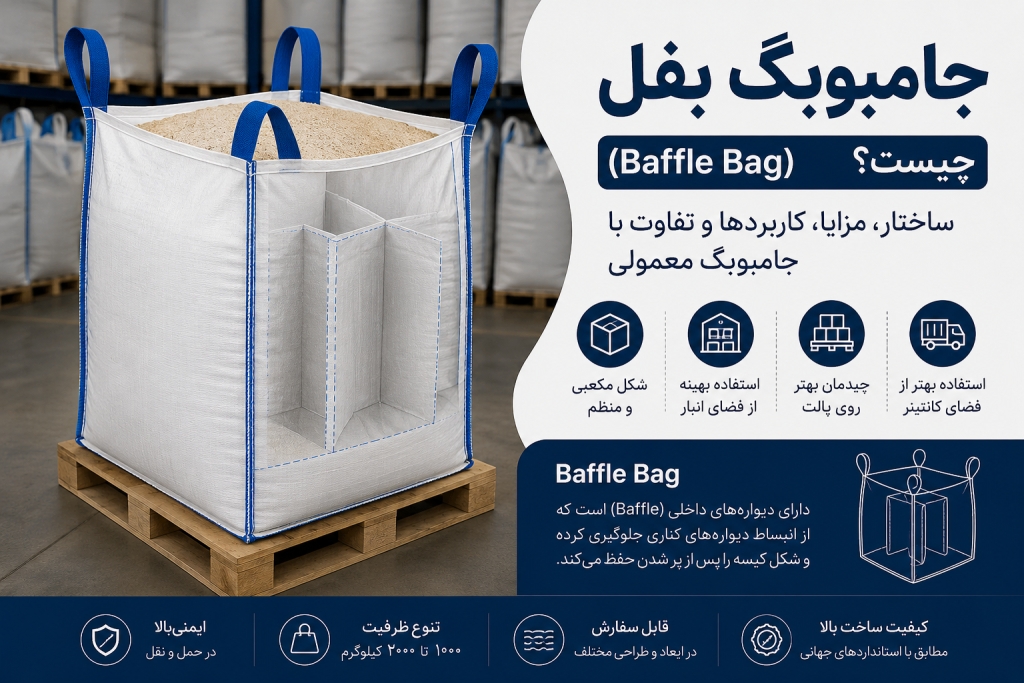
What Is a Baffle Bag?
A Baffle Bag, also known as a Baffle FIBC, Q-Bag, or Baffle Bulk Bag, is a specially designed type of Flexible Intermediate Bulk Container (FIBC) that uses internal fabric panels called baffles to control the shape of the bag when it is filled.
Unlike conventional bulk bags, which can bulge outward as the material inside expands against the walls, Baffle Bags are designed to maintain a more stable, square or cubic shape.
This structural design makes Baffle FIBCs particularly useful when efficient storage, palletization, container loading, and space optimization are important.
Baffle Bags are widely used for transporting and storing bulk materials such as chemicals, minerals, agricultural products, food ingredients, polymers, and construction materials.
How Does a Baffle Bag Work?
To understand how a Baffle Bag works, imagine filling a standard FIBC with powder or granular material.
As the bag fills, the pressure generated by the product pushes the fabric walls outward. As a result, the bag may become wider and more rounded than its original dimensions.
A Baffle FIBC uses specially positioned internal fabric panels to restrict this outward movement.
The basic process is:
Filling → Internal pressure → Baffles restrict wall expansion → More stable cubic shape
The baffles are typically sewn between the sides of the FIBC, helping maintain the bag’s overall geometry after filling.
This allows the filled bag to occupy space more efficiently compared with many conventional FIBCs.
What Are Baffles in an FIBC?
Baffles are internal fabric panels or strips sewn into an FIBC to control its expansion.
They are positioned inside the bulk bag and connect different sections of the bag’s walls.
Their primary function is not to increase the weight capacity of the bag, but to control its shape and improve space utilization.
Depending on the FIBC construction, baffles can be incorporated into different bag designs, including:
- Circular FIBC
- U-Panel FIBC
- 4-Panel FIBC
- Other customized FIBC constructions
This means that Baffle describes a structural feature rather than a completely separate FIBC construction category.
What Is a Q-Bag?
The term Q-Bag is commonly used to describe an FIBC designed with internal baffles that help maintain a cubic or square shape after filling.
Because of their controlled shape, Q-Bags can be particularly useful for applications where the available storage or transportation space is limited.
For example, a conventional FIBC may expand outward after filling, while a properly designed Q-Bag remains closer to its intended dimensions.
This can make the bags easier to stack and arrange on pallets or inside shipping containers.
Main Benefits of Baffle Bags
1. Better Shape Retention
The most important advantage of a Baffle Bag is its ability to maintain a more controlled shape after filling.
The internal baffles limit excessive outward expansion and help the FIBC retain a more cubic geometry.
This can be especially useful in warehouses and transportation environments where space efficiency is important.
2. Better Use of Storage Space
Conventional bulk bags may become rounded or bulged after filling.
This can create unused spaces between individual bags.
Baffle Bags reduce excessive bulging, allowing filled bags to be positioned more efficiently.
As a result, they can help improve the utilization of available warehouse space.
3. Improved Palletization
The more regular shape of a Baffle FIBC makes it easier to arrange bags on pallets.
More consistent dimensions can improve:
- Pallet stability
- Stacking efficiency
- Warehouse organization
- Transportation planning
However, the actual stacking performance depends on the bag design, product characteristics, filling method, and handling conditions.
4. Better Container Utilization
Space optimization is particularly important in international shipping.
When FIBCs are transported in containers, reducing unnecessary gaps between bags can improve the use of available container volume.
Baffle Bags can therefore be a practical option for exporters that need more predictable and efficient cargo arrangements.
The actual space savings depend on factors such as:
- Bag dimensions
- Product density
- Filling level
- Container dimensions
- Stacking configuration
- Handling method
5. Improved Load Stability
A more controlled cubic shape can also improve the stability of bags when they are placed next to or on top of each other.
This can be useful in industrial warehouses, distribution centers, and transportation operations.
Types of Baffle FIBC Bags
Baffle technology can be incorporated into different FIBC constructions.
Circular Baffle Bags
Circular FIBCs are manufactured using tubular fabric.
Internal baffles can be added to the construction to control the expansion of the bag after filling.
This combination can provide both efficient manufacturing and improved shape retention.
U-Panel Baffle Bags
U-Panel FIBCs are manufactured using a U-shaped body combined with additional panels.
Adding internal baffles helps control the outward movement of the walls and improves the overall shape of the filled bag.
4-Panel Baffle Bags
A 4-Panel FIBC consists of four main fabric panels sewn together.
Internal baffles can be incorporated into this structure to improve shape retention and reduce outward bulging.
This design can be suitable for applications where stable dimensions and efficient stacking are important.
Baffle Bag vs. Standard FIBC
One of the most common questions is whether a Baffle Bag is better than a conventional FIBC.
The answer depends on the application.
| Feature | Standard FIBC | Baffle FIBC |
|---|---|---|
| Shape after filling | May bulge outward | More controlled |
| Cubic shape | Limited | Better |
| Space utilization | Standard | Improved |
| Pallet stacking | Good | More organized |
| Container loading | Standard | Potentially more efficient |
| Shape stability | Depends on construction | Generally higher |
| Manufacturing complexity | Lower | Higher |
| Production cost | Usually lower | Usually higher |
| Space-limited applications | Standard | Highly suitable |
A standard FIBC can be a cost-effective solution for general bulk handling.
A Baffle FIBC is generally more appropriate when shape retention and space optimization are major priorities.
Does a Baffle Bag Have a Higher Weight Capacity?
Not necessarily.
This is an important point when selecting an FIBC.
The presence of internal baffles does not automatically increase the Safe Working Load (SWL) of the bag.
The maximum allowable load depends on the complete design and construction of the FIBC, including:
- Fabric specifications
- Yarn properties
- Stitching quality
- Lifting loops
- Body construction
- Bottom construction
- Filling and discharge design
- Safety requirements
- Testing procedures
For example, a 1,500 kg Baffle Bag does not become a 2,000 kg bag simply because it has internal baffles.
The SWL must always be specified and verified according to the manufacturer’s design and testing requirements.
Baffle Bag Applications
Baffle FIBCs can be used for many bulk materials and industrial applications.
Food Industry
Baffle Bags can be manufactured for certain food-grade applications when appropriate raw materials, manufacturing controls, and hygiene requirements are used.
They can be used for bulk handling of products such as:
- Food ingredients
- Powders
- Granular products
- Agricultural ingredients
Food-grade requirements should always be confirmed according to the specific product and destination market.
Chemical Industry
Baffle FIBCs are commonly considered for the transportation and storage of various powder and granular chemical products.
The exact bag construction should be selected according to the material properties and handling requirements.
Petrochemical Industry
Baffle Bags can be used for certain polymer and petrochemical products, particularly granular materials that require efficient bulk packaging and transportation.
Mining and Mineral Industry
They can also be used for transporting various dry minerals and granular materials.
The required fabric strength, SWL, discharge design, and lifting configuration depend on the specific application.
Agricultural Industry
Potential applications include:
- Fertilizers
- Seeds
- Grains
- Agricultural materials
- Other dry bulk products
Construction Industry
Baffle FIBCs can be used for selected dry construction materials and powders where bulk packaging is appropriate.
Is a Baffle Bag Suitable for Export?
Yes.
Baffle Bags can be particularly useful for export applications because efficient use of container space is often important in international transportation.
Their more controlled shape can help create a more predictable loading arrangement.
However, exporters should consider more than just the bag shape.
Important factors include:
- SWL
- Safety Factor
- Bag dimensions
- Product density
- Filling method
- Discharge system
- Lifting configuration
- Destination requirements
- Applicable standards
- Storage conditions
- Transportation conditions
For FIBCs intended for non-dangerous solid materials, ISO 21898:2024 specifies requirements relating to materials, construction, design, type testing, and marking.
Therefore, selecting a Baffle FIBC should always involve reviewing the complete technical specification rather than relying only on the term “Baffle Bag.”
Can a Baffle Bag Have an Inner Liner?
Yes.
A Baffle FIBC can be manufactured with an inner polyethylene liner, depending on the requirements of the application.
An FIBC liner may be used when the product requires additional protection against:
- Moisture
- Contamination
- Product leakage
- Direct contact with polypropylene fabric
The appropriate liner material and design depend on the product, filling temperature, discharge method, and storage conditions.
1,500 kg and 2,000 kg Baffle Bags
Baffle Bags can be manufactured in different capacities and dimensions.
For example, manufacturers may produce:
- 1,000 kg Baffle Bags
- 1,500 kg Baffle Bags
- 2,000 kg Baffle Bags
- Custom-capacity Baffle FIBCs
However, choosing a bag based only on its weight capacity is not sufficient.
The following specifications should also be considered:
- Product weight
- Bulk density
- Bag dimensions
- Pallet dimensions
- Maximum height
- Filling system
- Discharge system
- Lifting configuration
- Liner requirements
- Lamination
- UV protection
- Safety Factor
- Storage conditions
What Are the Disadvantages of Baffle Bags?
Although Baffle FIBCs offer several advantages, they are not necessarily the best choice for every application.
Higher Production Cost
Because Baffle Bags require additional internal fabric components and more complex sewing operations, their production cost can be higher than that of standard FIBCs.
More Complex Design
The dimensions and positioning of the baffles must be properly designed according to the bag’s intended use.
Poorly selected dimensions or construction can negatively affect filling, discharge, or handling performance.
Not Necessary for Every Application
If warehouse space is not limited and the shape of the filled bag is not important, a standard FIBC may provide a more economical solution.
How to Choose the Right Baffle Bag
Before ordering a Baffle FIBC, it is important to provide the manufacturer with accurate technical information.
Important specifications include:
- Required capacity
- Product type
- Bulk density
- Required bag dimensions
- FIBC construction
- Number and type of lifting loops
- Filling inlet design
- Discharge outlet design
- Inner liner requirements
- Lamination requirements
- UV protection
- Required Safety Factor
- Storage conditions
- Transportation conditions
- Printing requirements
- Applicable standards
The better these specifications are defined, the easier it is to manufacture an FIBC that matches the actual application.
Baffle Bag Standards
It is important to understand that Baffle is not a standalone safety standard.
It is a structural feature used in the design of an FIBC.
For non-dangerous solid materials, ISO 21898:2024 covers requirements related to FIBC materials, construction, design, testing, and marking.
Therefore, when purchasing a Baffle Bag, buyers should evaluate the complete technical specification, including:
- SWL
- Safety Factor
- Fabric specification
- Stitching
- Lifting loops
- Filling and discharge design
- Testing
- Marking
- Intended application
Baffle Bag or Standard FIBC: Which One Should You Choose?
The right choice depends on your priorities.
Choose a standard FIBC when:
- Cost efficiency is the main priority.
- Available storage space is sufficient.
- The shape of the filled bag is not critical.
- The application is relatively straightforward.
Choose a Baffle FIBC when:
- Space optimization is important.
- You need a more cubic shape.
- Pallet stacking matters.
- Container utilization is important.
- More predictable bag dimensions are required.
- Warehouse space is limited.
In simple terms:
Standard FIBCs are suitable for general bulk handling, while Baffle FIBCs are particularly useful when shape retention, stacking, and space efficiency are important.
Conclusion
A Baffle Bag is a specially engineered FIBC designed with internal fabric baffles that limit excessive outward expansion and help the filled bag maintain a more cubic shape.
The main advantages of Baffle FIBCs include:
- Better shape retention
- More efficient use of storage space
- Improved palletization
- Potentially better container utilization
- Better load organization
- More predictable dimensions
However, Baffle construction does not automatically increase the load capacity of an FIBC.
The correct bag should be selected based on the product, bulk density, required SWL, dimensions, filling and discharge systems, transportation conditions, and applicable standards.
For companies handling large volumes of bulk materials, especially where warehouse space, pallet stability, or container loading efficiency are important, a properly designed Baffle FIBC can be a highly practical packaging solution.