Introduction
Agricultural industries handle large quantities of bulk materials such as fertilizers, seeds, grains, animal feed ingredients and other agricultural raw materials. Packaging these products requires containers that can withstand heavy loads while also allowing efficient transportation, storage and discharge.
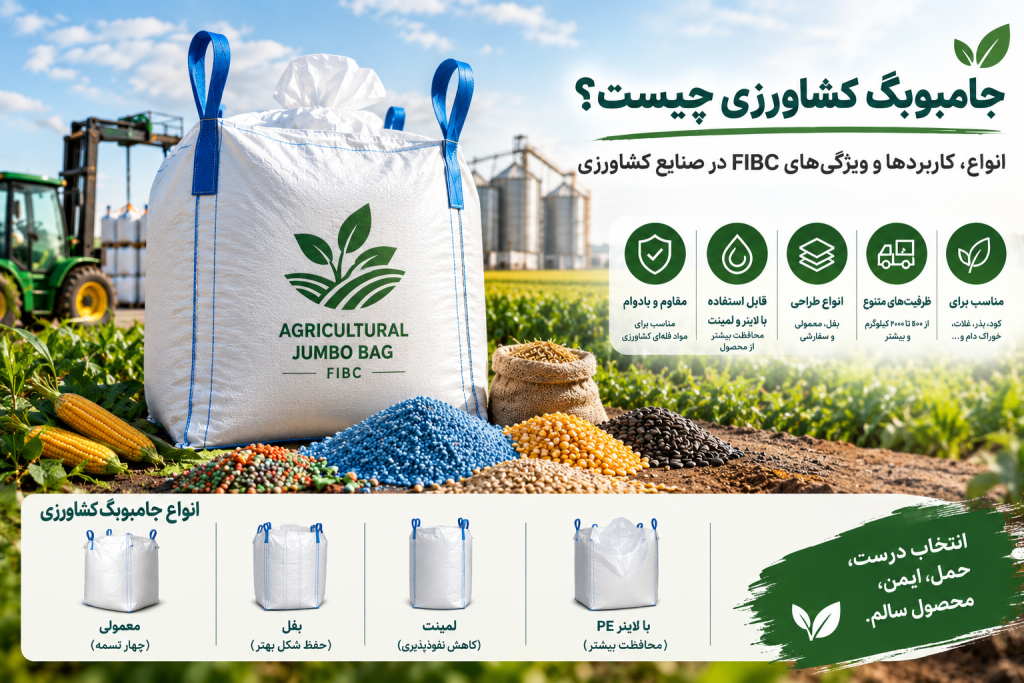
One solution widely used for bulk material handling is the Agricultural Jumbo Bag, also known as an Agricultural FIBC or Bulk Bag.
Agricultural jumbo bags are generally manufactured from woven polypropylene (PP) fabric and can be customized according to the type of product, required capacity, storage conditions and discharge system.
Depending on the application, an agricultural FIBC can be manufactured with features such as a PE liner, laminated fabric, baffle construction, different filling spouts and discharge spouts.
In this guide, we explain what an agricultural jumbo bag is, its main applications, different types and the key factors to consider when selecting an FIBC for agricultural products.
What Is an Agricultural Jumbo Bag?
An agricultural jumbo bag is a high-capacity industrial bag belonging to the FIBC (Flexible Intermediate Bulk Container) family.
It is designed for packaging, transporting and handling bulk agricultural materials such as fertilizers, grains, seeds and certain agricultural raw materials.
The body of the bag is generally made from woven polypropylene (PP) fabric.
Depending on the application, the bag can also include:
- Lifting loops
- Filling spout
- Discharge spout
- PE liner
- Laminated fabric
- Baffle construction
FIBC design can be customized according to the product and handling process.
The current ISO 21898:2024 standard covers material, construction, design, type testing and marking requirements for FIBCs intended for non-dangerous solid materials in powder, granular or paste form.
What Are Agricultural Jumbo Bags Used For?
Agricultural FIBCs can be used throughout different stages of the agricultural supply chain.
Common applications include:
- Fertilizer packaging
- Granular fertilizer transportation
- Seed packaging
- Grain transportation
- Animal feed ingredients
- Bulk agricultural materials
- Temporary storage of agricultural products
- Agricultural product exports
- Transportation of raw materials between production and storage facilities
The appropriate FIBC design depends on the characteristics of the specific product.
For example, an FIBC suitable for dry granular material may not necessarily be the best option for a fine powder or a moisture-sensitive product.
Why Use Jumbo Bags for Agricultural Products?
One of the main advantages of FIBC packaging is its high capacity relative to the weight of the packaging itself.
FIBCs can also be designed with lifting loops that allow them to be handled using suitable equipment.
The main potential advantages of agricultural jumbo bags include:
- High capacity
- Relatively low packaging weight
- Mechanical handling capability
- Customizable design
- Optional PE liner
- Optional lamination
- Different filling and discharge systems
- Foldable construction after emptying
- Fewer individual packages during transportation
These features can simplify logistics when large quantities of agricultural materials need to be transported.
What Material Are Agricultural Jumbo Bags Made Of?
The most common material used for FIBC manufacturing is polypropylene (PP).
Polypropylene is converted into tapes and woven into fabric used for the main body of the jumbo bag.
An agricultural FIBC may consist of:
- Woven PP body fabric
- Lifting loops
- Sewing thread
- Filling spout
- Discharge spout
- Internal PE liner
- Laminated coating
The fabric, lifting-loop and stitching specifications should be selected according to the bag capacity and intended application.
What Is a Fertilizer Jumbo Bag?
One of the most important agricultural applications of FIBC packaging is fertilizer transportation and packaging.
Fertilizers can be powdery, granular or crystalline, and their packaging requirements may differ.
A fertilizer jumbo bag can be used for:
- Chemical fertilizers
- Granular fertilizers
- Mineral fertilizers
- Fertilizer raw materials
- Certain powdered fertilizers
The fabric, stitching, discharge system and optional liner should be selected according to the fertilizer’s physical and chemical characteristics.
Chemical Fertilizer Jumbo Bags
A chemical fertilizer jumbo bag should be selected according to the physical and chemical properties of the fertilizer.
Not all fertilizers behave in the same way.
Some may be moisture-sensitive, some granular and others powder-based.
Before ordering an FIBC, it is useful to determine:
- Fertilizer type
- Bulk density
- Particle size
- Moisture sensitivity
- Filling method
- Discharge method
- Storage duration
The compatibility of the product with the FIBC materials should also be considered.
Jumbo Bags for Seeds
Seeds may also be transported in bulk packaging under suitable conditions.
However, greater attention may be required to:
- Moisture
- Packaging cleanliness
- Environmental exposure
- Seed size and shape
- Storage conditions
- Storage duration
For sensitive or food-related seed applications, applicable hygiene and packaging requirements should be evaluated separately.
Therefore, not every PP jumbo bag should automatically be considered suitable for every type of seed.
Grain Jumbo Bags
Grains and other agricultural materials in granular form can also be transported using bulk bags.
Depending on the product, agricultural FIBCs may be used for:
- Wheat
- Corn
- Barley
- Rice
- Edible seeds
- Animal-feed raw materials
The FIBC should be selected according to product weight, moisture conditions, storage environment and applicable requirements.
1000kg Agricultural Jumbo Bag
The 1000kg agricultural jumbo bag is a practical capacity for transporting many bulk agricultural materials.
Depending on the product, a 1000kg FIBC can be customized with:
- PE liner
- Laminated fabric
- Large filling spout
- Discharge spout
- Four lifting loops
- Baffle construction
However, a 1000kg capacity alone does not determine the complete technical specification of the FIBC.
The handling, filling, lifting and discharge conditions should also be considered.
Agricultural Jumbo Bag with PE Liner
In some agricultural applications, using an internal PE liner may be beneficial.
A PE liner is a separate layer installed inside the FIBC and can provide different protective characteristics depending on its design.
Potential purposes include:
- Reducing permeability
- Providing a smoother internal surface
- Reducing the release of fine particles
- Providing additional product protection
- Improving discharge characteristics in some applications
The liner type and thickness should be selected according to the product.
Laminated Agricultural Jumbo Bags
In some applications, a laminated jumbo bag may be appropriate.
Lamination involves applying a coating to the woven fabric and can modify certain permeability and protective characteristics of the FIBC.
The Lamination may be considered when:
- Particle containment is important
- Additional environmental protection is required
- The product contains fine particles
Lamination should not be confused with an internal liner.
The Lamination is applied to the fabric, while a liner is installed inside the bag.
Baffle Jumbo Bags for Agricultural Products
A baffle jumbo bag is an FIBC design that uses internal fabric panels to help maintain the bag’s shape after filling.
Potential advantages include:
- Better shape retention
- Reduced side bulging
- More efficient storage-space utilization
- More uniform stacking
- More cubic or rectangular shape after filling
However, a baffle design is not automatically suitable for every agricultural product.
The product characteristics and actual handling conditions should be considered.
Filling and Discharge Spouts
The filling and discharge systems should be compatible with the equipment used by the customer.
Filling Spout
The top filling spout is used to load agricultural material into the FIBC.
Its size and configuration can be customized according to the filling system.
Discharge Spout
The bottom discharge spout is used to empty the product from the bag.
It can be designed for rapid or controlled discharge depending on the product and unloading equipment.
Moisture-Resistant Agricultural Jumbo Bags
Moisture control is an important consideration for many agricultural products.
However, a standard woven PP FIBC should not automatically be considered completely waterproof.
When additional moisture protection is required, options may include:
- Lamination
- PE liner
- Combination of liner and lamination
The appropriate solution depends on product sensitivity, environmental conditions and storage duration.
Agricultural Jumbo Bags for Export
Agricultural FIBCs can also be used for transporting and exporting bulk agricultural materials.
For export applications, it is important to consider:
- Bag capacity
- Dimensions
- Transportation method
- Container conditions
- Transportation duration
- Climate conditions
- Loading and discharge methods
- Destination-country requirements
Where specific regulations apply, the FIBC design should be selected accordingly.
Safety Factor in Agricultural Jumbo Bags
The Safety Factor (SF) is an important technical characteristic of an FIBC.
It should be considered together with:
- Safe Working Load
- Fabric specifications
- Lifting-loop design
- Stitching
- Handling conditions
A bag designed for a specific capacity is not automatically suitable for every lifting method or reuse scenario.
FIBCA’s safe-handling guidance emphasizes appropriate filling, emptying, lifting, transportation and storage practices and recommends consulting the supplier regarding the specific application.
Important Factors When Buying an Agricultural Jumbo Bag
Before ordering an agricultural FIBC, determine:
1. Product Type
Identify exactly what material will be placed inside the bag.
2. Product Weight
Determine the required capacity.
3. Product Form
Specify whether the product is powder, granule, grain or another form.
4. Moisture Sensitivity
Determine whether a PE liner or lamination is required.
5. Filling System
Specify the filling equipment and required filling-spout configuration.
6. Discharge System
Determine how the material will be discharged.
7. Handling Method
Specify whether the bag will be handled by forklift, crane or another suitable system.
8. Storage Conditions
Specify the expected storage environment and duration.
9. Product Requirements
Any special hygiene, chemical, export or regulatory requirements should be communicated before production.
Proper Storage of Agricultural Jumbo Bags
Proper storage is important for both filled and empty FIBCs.
Jumbo bags should preferably be:
- Stored in a dry environment
- Protected from prolonged direct sunlight
- Protected from sharp objects
- Kept on a suitable surface
- Kept away from incompatible chemicals
- Loaded only within the specified Safe Working Load
The body, lifting loops, seams and filling/discharge spouts should also be inspected before use.
FIBCA provides specific guidance covering filling, emptying, forklift/crane handling, storage and transportation of FIBCs.
Can Agricultural Jumbo Bags Be Reused?
Reusability depends on the FIBC’s design and specifications.
Not every jumbo bag is designed for multiple use.
A bag should not be reused simply because it appears visually intact.
For FIBCs designed for reuse, the following should be inspected before each use:
- Body fabric
- Lifting loops
- Seams
- Attachment points
- Filling spout
- Discharge spout
If damage that could affect the bag’s strength is detected, it should not be reused without appropriate evaluation.
Agricultural Jumbo Bag vs Conventional Bags
| Feature | Agricultural Jumbo Bag | Conventional Bag |
|---|---|---|
| Capacity | High | Usually lower |
| Mechanical handling | Suitable | More limited |
| Lifting loops | Available | Usually unavailable |
| PE liner | Available | More limited |
| Discharge spout | Customizable | Usually unavailable |
| Customization | High | Lower |
| Bulk material handling | Suitable | More limited |
Jumbo bags become particularly useful when large quantities of material need to be handled mechanically.
How to Choose the Best Agricultural Jumbo Bag
A practical selection process includes:
Step 1: Identify the product.
2: Determine the required weight per bag.
3: Specify whether the material is powder, granule or grain.
4: Evaluate moisture sensitivity.
5: Select filling and discharge configurations.
6: Determine whether a PE liner or lamination is required.
7: Consider baffle construction if shape retention is important.
8: Specify lifting and handling equipment.
9: Define storage conditions and duration.
10: Obtain the FIBC’s technical specifications, Safe Working Load and Safety Factor from the manufacturer.
Frequently Asked Questions About Agricultural Jumbo Bags
What is an agricultural jumbo bag?
An agricultural jumbo bag is a high-capacity FIBC used for packaging and transporting bulk agricultural materials such as fertilizers, grains, seeds and certain agricultural raw materials.
What products can be packed in agricultural jumbo bags?
Depending on the design, FIBCs can be used for fertilizers, granular materials, certain grains, seeds and other agricultural bulk products.
Are jumbo bags suitable for fertilizers?
Yes. FIBCs can be used for many powdered and granular fertilizers, provided that the bag is designed according to the product’s physical and chemical characteristics.
Are agricultural jumbo bags moisture-resistant?
A standard woven PP FIBC is not automatically fully moisture-proof. PE liners, lamination or a combination of both may provide additional protection.
Is a 1000kg jumbo bag suitable for agriculture?
A 1000kg FIBC can be suitable for many agricultural bulk materials, but its fabric, lifting system and construction should be selected according to the product and handling conditions.
What is the advantage of a baffle jumbo bag?
A baffle FIBC can maintain a more regular shape after filling and may improve storage-space efficiency in suitable applications.
Can jumbo bags be used for seeds?
They can be used for certain seed applications, provided that the FIBC design meets the product’s storage, hygiene and protection requirements.
Can agricultural jumbo bags be reused?
Only FIBCs specifically designed and approved for reuse should be reused, and they should be inspected before each use.
Conclusion
An agricultural jumbo bag is a practical bulk-packaging solution for transporting and handling agricultural materials such as fertilizers, grains, seeds, granular materials and agricultural raw materials.
Depending on the application, FIBCs can be customized with PE liners, laminated fabric, baffle construction, different filling and discharge spouts and various capacities.
However, choosing the right agricultural jumbo bag requires more than simply selecting a capacity. Product type, particle size, moisture sensitivity, filling method, discharge system, lifting equipment, storage conditions and specific product requirements should all be considered.
The best agricultural FIBC is therefore the one whose specifications are matched to the actual product, transportation, storage and discharge conditions.