Introduction
Jumbo Bags, also known as FIBC (Flexible Intermediate Bulk Containers) or Bulk Bags, are widely used for storing, handling, and transporting bulk materials in industries such as food processing, chemicals, petrochemicals, agriculture, mining, construction, and manufacturing.
Most FIBC bags are manufactured from woven polypropylene (PP) fabric, which provides high mechanical strength and excellent load-bearing performance.
However, the woven fabric alone may not provide the level of protection required for certain products.
Some materials require additional protection against:
- Moisture
- Dust and fine particles
- Product contamination
- Particle leakage
- Direct contact with the woven PP fabric
This is where lamination can provide an important advantage.
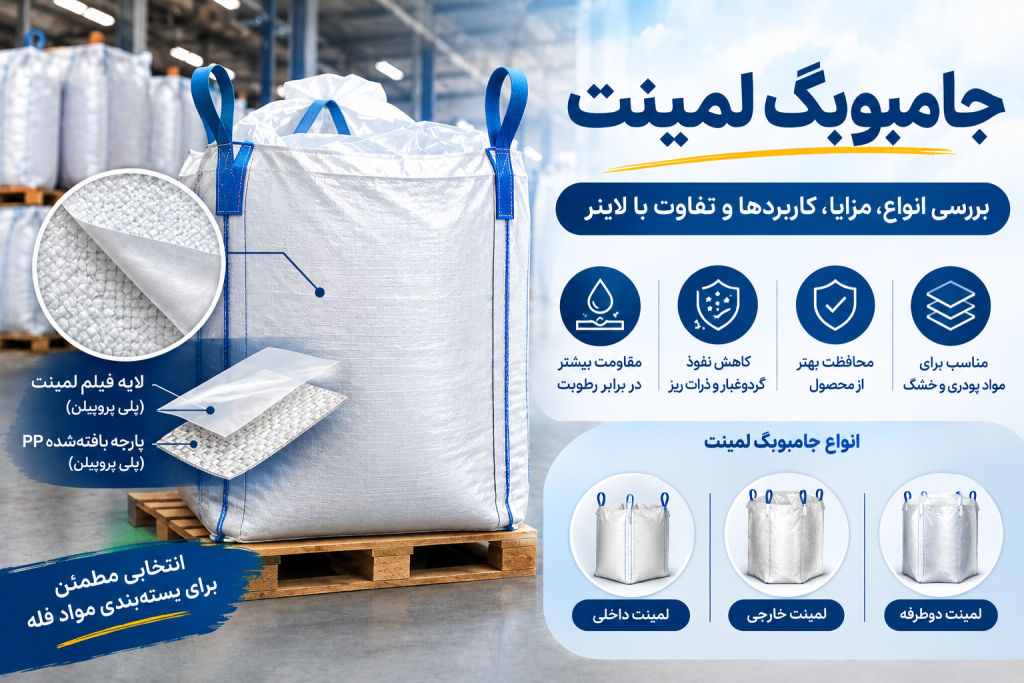
A Laminated Jumbo Bag combines woven polypropylene fabric with an additional polymer film layer designed to reduce the passage of moisture, dust, and fine particles through the fabric.
But what exactly is a laminated Jumbo Bag? How is it different from a standard FIBC? Can it replace a PE liner? And which products are best suited for laminated bulk bags?
This complete guide answers these questions and explains the main types, benefits, applications, limitations, and selection criteria for laminated FIBC bags.
What Is a Laminated Jumbo Bag?
A Laminated Jumbo Bag is an FIBC bulk bag made from woven polypropylene fabric with an additional thin polymer film laminated onto the fabric.
The main structure of a conventional Jumbo Bag consists of PP woven fabric. Because the fabric is woven from polypropylene tapes, very small openings naturally exist between the woven elements.
Depending on the fabric construction, these openings can allow some air and very fine particles to pass through.
In a laminated FIBC, an additional polymer film is applied to one side of the woven fabric. This film partially closes the openings and creates an additional protective barrier.
In simple terms:
Standard Jumbo Bag:
PP woven fabric → no additional laminated film
Laminated Jumbo Bag:
PP woven fabric + polymer film → additional protection against moisture and fine particles
However, lamination should not automatically be interpreted as complete waterproofing. The final performance depends on the film, lamination quality, seams, stitching, filling and discharge openings, and the overall FIBC design.
What Material Is Used for Jumbo Bag Lamination?
Many laminated FIBC bags use a polypropylene (PP) film as the coating or laminated layer.
The main purpose of this film is to create an additional barrier over the woven fabric and reduce the passage of:
- Moisture
- Dust
- Fine particles
- Certain external contaminants
The exact film structure and specifications can vary depending on the manufacturer and application.
Therefore, when ordering a laminated Jumbo Bag, it is better not to specify only “laminated.” Important technical specifications such as film type, thickness, construction, and intended application should also be defined.
How Are Laminated Jumbo Bags Manufactured?
The exact manufacturing process depends on the equipment and design used by the FIBC manufacturer.
In general, the process starts with the production of woven PP fabric.
A polymer film is then laminated onto the fabric surface.
Once the laminated fabric is ready, it can be converted into a finished FIBC through processes such as:
- Fabric cutting
- Component preparation
- Body sewing
- Lifting loop installation
- Filling and discharge spout installation
- Printing, when required
- Quality inspection
- Final packaging
The quality of the seams and stitching is particularly important because the laminated surface alone does not determine the performance of the finished bag.
The filling and discharge openings, seams, corners, and lifting components must also be designed according to the intended application.
Types of Laminated Jumbo Bags
Laminated FIBC bags can be classified in several ways, including the position of the laminated layer and the overall bag construction.
1. Internally Laminated Jumbo Bag
In this design, the laminated film is positioned on the inside surface of the woven PP fabric.
This can be useful for products that require reduced contact with the woven fabric or a smoother internal surface.
For some powders, a smoother internal surface can also help reduce product accumulation inside the fabric structure.
2. Externally Laminated Jumbo Bag
In this design, the polymer film is positioned on the outside surface of the woven fabric.
One potential advantage is an additional external protective surface against certain environmental conditions.
3. Double-Sided Laminated Jumbo Bag
Some specialized FIBC designs may use laminated or coated layers on both sides of the woven fabric.
This construction can provide additional protection, although it is not necessarily required for every application.
The choice should always be based on the product and the required level of protection.
Benefits of Laminated Jumbo Bags
Laminated Jumbo Bags can offer several advantages compared with standard uncoated FIBC bags.
Improved Moisture Resistance
One of the main reasons for using lamination is to improve the fabric’s resistance to moisture penetration.
The laminated film covers much of the open structure of the woven fabric, helping reduce moisture transfer through the bag wall.
This can be particularly useful for materials that should be protected from humidity during storage and transportation.
However, moisture resistance is not the same as complete waterproofing.
Better Dust and Fine-Particle Control
Some powders and very fine materials can escape through the small openings in woven PP fabric.
A laminated layer can help close these pathways and reduce the leakage of fine particles.
For this reason, laminated FIBC bags can be useful in applications where dust control and sift resistance are important.
For extremely fine powders, however, the entire FIBC construction should be evaluated rather than relying on lamination alone.
Improved Product Protection
The additional laminated layer creates another barrier between the product and the external environment.
This can help reduce exposure to environmental contamination and provide additional protection during storage and transportation.
Suitable for Many Powdered Materials
Laminated Jumbo Bags can be suitable for various dry and powdered products, including:
- Cement
- Flour
- Salt
- Mineral powders
- Chemical powders
- Agricultural products
- Certain petrochemical materials
The appropriate FIBC construction should always be selected based on the physical and chemical characteristics of the product.
Smoother Internal Surface
When the laminated layer is positioned on the inside, it can create a smoother product-contact surface.
This can be beneficial for some powders because less product may become trapped within the woven fabric structure.
Disadvantages and Limitations of Laminated Jumbo Bags
Despite their benefits, laminated FIBC bags are not the ideal solution for every application.
Reduced Air Permeability
Uncoated woven PP fabric allows a certain amount of air to pass through.
Lamination reduces this air permeability.
Therefore, products that require ventilation may be better suited to an uncoated FIBC design.
Higher Cost
The additional film and lamination process can increase the manufacturing cost compared with a standard uncoated Jumbo Bag.
However, the additional cost may be justified when moisture resistance, dust control, or improved product protection is important.
Lamination Does Not Always Replace a PE Liner
A laminated layer is integrated with the woven fabric, while a PE Liner is a separate inner layer installed inside the FIBC.
For applications requiring a higher level of internal product protection, a PE liner may be more suitable.
In some cases, both solutions can be used together.
Laminated Jumbo Bag vs. Standard Jumbo Bag
| Feature | Standard Jumbo Bag | Laminated Jumbo Bag |
|---|---|---|
| Main material | PP woven fabric | PP woven + laminated film |
| Air permeability | Higher | Lower |
| Moisture resistance | Standard | Improved |
| Dust control | More limited | Better |
| Fine-powder applications | Application dependent | Often more suitable |
| Cost | Usually lower | Usually higher |
| Surface | Woven | Coated/laminated surface |
| PE liner requirement | Application dependent | May still be required |
In general, if a product is sensitive to moisture or contains very fine particles, a Laminated Jumbo Bag may be a better choice than a standard uncoated FIBC.
However, product characteristics and operating conditions should always determine the final specification.
Laminated Jumbo Bag vs. PE Liner
This is one of the most important differences to understand when selecting an FIBC solution.
In a Laminated Jumbo Bag, the polymer film is directly attached to the woven PP fabric.
In a PE Liner FIBC, a separate polyethylene liner is placed inside the Jumbo Bag.
Therefore:
Laminated FIBC:
PP woven fabric + laminated polymer film
Lined FIBC:
PP woven fabric + separate PE inner liner
A PE liner can provide a more distinct internal barrier when higher levels of product protection are required.
Lamination, on the other hand, is an integrated solution that can improve the moisture and dust resistance of the woven fabric.
Which One Is Better?
There is no universal answer.
The right choice depends on:
- Product type
- Moisture sensitivity
- Particle size
- Required protection level
- Filling method
- Discharge method
- Storage conditions
- Transportation conditions
For certain demanding applications, a combination of Laminated FIBC + PE Liner can also be considered.
Is a Laminated Jumbo Bag Waterproof?
One common misconception is that a laminated Jumbo Bag is automatically completely waterproof.
It is not necessarily waterproof.
Lamination can improve resistance to moisture penetration, but complete water resistance depends on the entire bag construction.
Important factors include:
- Film type
- Film thickness
- Lamination location
- Stitching quality
- Seam construction
- Filling spout
- Discharge spout
- Closure system
Therefore, a laminated FIBC should not automatically be described as a 100% waterproof Jumbo Bag unless the complete design has been tested and specified for that requirement.
Applications of Laminated Jumbo Bags
Laminated FIBC bags are used in a wide range of industries.
Cement Industry
Cement is a powdered material that can be affected by moisture.
Laminated Jumbo Bags can therefore be useful for improving moisture protection and controlling dust during handling and transportation.
Chemical Industry
Many dry chemical powders require protection against moisture, contamination, and particle leakage.
Laminated FIBC bags can be considered for these applications, provided that the polymer film and all bag components are compatible with the chemical product.
Mineral Industry
Mineral powders and fine materials can benefit from improved dust control.
Examples include:
- Calcium carbonate
- Kaolin
- Talc
- Mineral powders
- Fine-grained industrial materials
Food Industry
Laminated Jumbo Bags can be used in certain food-related applications where additional protection and dust control are required.
However, being laminated does not automatically make an FIBC Food Grade.
For direct food-contact applications, the raw materials, manufacturing process, hygiene controls, and applicable food-contact regulations must be evaluated.
Agriculture
Laminated FIBC bags can also be used for certain fertilizers and dry agricultural materials.
The choice between laminated and uncoated FIBC should depend on the product’s moisture sensitivity and ventilation requirements.
What Materials Are Laminated Jumbo Bags Suitable For?
Laminated FIBC bags can be suitable for many dry, powdered, and granular products, such as:
- Powdered materials
- Fine particles
- Cement
- Certain fertilizers
- Salt
- Flour
- Mineral powders
- Dry chemicals
- Selected petrochemical products
- Granular materials requiring additional protection
The exact FIBC design should always be selected according to the characteristics of the material being packed.
When Is an Uncoated Jumbo Bag Better?
A standard uncoated Jumbo Bag may be a better option when the product requires greater air circulation and has relatively low sensitivity to moisture.
Some agricultural and granular products, for example, may benefit from greater ventilation.
In such cases, reducing air permeability through lamination may not provide a meaningful advantage.
The key question is:
Does the product need more protection or more ventilation?
Can Lamination Be Combined With a PE Liner?
Yes.
In some FIBC designs, lamination and an internal liner can be used together.
The structure may be:
PP woven fabric + lamination + PE liner
This creates multiple protective layers and can be considered for applications requiring higher product protection.
However, adding more layers is not always better.
The additional material can affect:
- Cost
- Weight
- Handling
- Product discharge
- Manufacturing complexity
Therefore, the design should be based on the actual requirements of the product.
What Is a Laminated Baffle Jumbo Bag?
Different FIBC features can be combined in a single bag.
For example:
Baffle FIBC + Lamination
In this construction, internal baffles help maintain a more cubic shape after filling, while the laminated layer provides additional protection against moisture and fine-particle passage.
Therefore, baffles and lamination serve different functions and can be used together.
For applications requiring both space-efficient shape and additional product protection, a laminated Baffle FIBC can be considered.
What Should You Consider When Ordering a Laminated Jumbo Bag?
Before ordering a laminated FIBC, it is important to define the following specifications.
1. Product Type
Is the material:
- Powder
- Granular
- Pellet
- Agricultural product
- Chemical
- Mineral
- Food ingredient
2. Moisture Sensitivity
Does the product need additional protection against humidity?
3. Particle Size
Are the particles extremely fine?
If so, dust and sift resistance may be important.
4. Filling Method
Will the bag be filled manually, automatically, through a filling spout, or through specialized equipment?
5. Discharge Method
How will the product be removed from the FIBC?
The discharge design can affect the overall bag specification.
6. Bag Capacity
Common capacities may include:
- 500 kg
- 1,000 kg
- 1,500 kg
- 2,000 kg
The actual safe working load must be specified according to the FIBC design and applicable requirements.
7. Lamination Type
Determine whether internal, external, or double-sided lamination is required.
8. PE Liner Requirement
Determine whether lamination alone is sufficient or whether an additional PE FIBC liner is required.
9. Storage and Transportation Conditions
Consider whether the bags will be stored:
- Indoors
- Outdoors
- In humid environments
- In dry warehouses
- During long-distance transportation
- For export
Laminated Jumbo Bags for 1,500 kg and 2,000 kg Loads
The capacity of a Jumbo Bag does not, by itself, determine the required lamination specification.
For example, a 1,500 kg FIBC used for a mineral powder may require a different construction from another 1,500 kg bag used for a moisture-sensitive chemical product.
The same principle applies to 2,000 kg Jumbo Bags.
Therefore:
Jumbo Bag Capacity ≠ Lamination Specification
The correct specification depends on:
Product + Load + Environmental Conditions + Filling/Discharge Method + Required Protection
How to Choose the Best Laminated Jumbo Bag
You can follow the steps below when selecting a laminated FIBC.
Step 1: Identify the Product
Determine exactly what material will be packed inside the Jumbo Bag.
Step 2: Evaluate Product Sensitivity
Determine whether the material is sensitive to:
- Moisture
- Dust
- Contamination
- Air exposure
- Static electricity
Step 3: Evaluate Particle Size
Fine powders require greater attention to dust and sift resistance.
Step 4: Choose the FIBC Construction
Depending on the application, consider:
- Standard FIBC
- Laminated FIBC
- Lined FIBC
- Laminated FIBC + PE Liner
Step 5: Define Additional Features
Depending on the application, the bag may also require:
- Baffles
- Form-Fit Liner
- Anti-Static properties
- Food-contact compliant materials
- Specialized filling and discharge systems
Step 6: Test Samples Before Mass Production
For demanding or sensitive applications, testing a sample under actual or simulated operating conditions is recommended before placing a large production order.
Frequently Asked Questions About Laminated Jumbo Bags
What is a Laminated Jumbo Bag?
A Laminated Jumbo Bag is an FIBC bulk bag made from woven polypropylene fabric with an additional polymer film laminated onto the fabric. The film helps improve moisture resistance and reduce the passage of dust and fine particles.
Are Laminated Jumbo Bags Waterproof?
Not necessarily. Lamination improves moisture resistance, but complete waterproofing depends on the film, seams, closures, spouts, and overall bag construction.
Is a Laminated Jumbo Bag Better Than a Standard Jumbo Bag?
For moisture-sensitive products, powders, and applications requiring improved dust control, a laminated FIBC can be a better choice. However, products that require ventilation may be better suited to an uncoated FIBC.
What Is the Difference Between a Laminated Jumbo Bag and a PE Liner?
In a laminated FIBC, the polymer film is attached directly to the woven PP fabric. A PE liner is a separate inner layer installed inside the Jumbo Bag.
Are Laminated Jumbo Bags Suitable for Cement?
Yes. Laminated FIBC bags can be suitable for cement and other dry powdered materials because the laminated layer can help reduce moisture penetration and fine-particle leakage.
Are Laminated Jumbo Bags Food Grade?
Not automatically. Lamination alone does not make an FIBC Food Grade. For food-contact applications, the raw materials, manufacturing process, hygiene requirements, and applicable regulations must be evaluated.
Conclusion
A Laminated Jumbo Bag is an FIBC bulk bag made from woven polypropylene fabric with an additional polymer film layer.
The main benefits of laminated FIBC bags include:
- Improved moisture resistance
- Better dust control
- Reduced leakage of fine particles
- Additional product protection
- A smoother coated surface in certain constructions
- Suitability for many dry and powdered materials
However, a laminated Jumbo Bag is not automatically the best solution for every product.
If a product requires greater ventilation, an uncoated FIBC may be more suitable. If the product requires a stronger internal barrier, a PE Liner may provide a better solution. In demanding applications, lamination and a PE liner can also be combined.
Ultimately, the correct Jumbo Bag should be selected according to:
Product type + moisture sensitivity + particle size + filling method + discharge method + storage conditions + transportation requirements + required protection level
Therefore, a laminated Jumbo Bag should not simply be considered a “thicker Jumbo Bag.” Lamination is a specific engineering feature of FIBC construction that can improve packaging performance for particular applications.
For manufacturers, exporters, and buyers of bulk packaging, understanding the difference between standard FIBC, laminated FIBC, and PE-lined FIBC is essential for selecting the right packaging solution.