Jumbo bags, also known as Flexible Intermediate Bulk Containers (FIBCs), are widely used for packaging, storing, and transporting bulk materials. They serve industries such as petrochemicals, mining, agriculture, construction, food processing, and plastic manufacturing. This guide explores the jumbo bag raw materials used in jumbo bag manufacturing, explains the role of each component, and highlights the factors buyers should consider when choosing an industrial bulk bag.
One of the most important factors affecting jumbo bag quality is the material used in its construction. Polymer type, yarn quality, woven fabric specifications, lifting loops, stitching, lamination, and inner liners all influence the bag’s strength, durability, safety, and final price.
What Are jumbo bag raw materials?
Jumbo bag material refers to the raw materials used to manufacture the bag body, lifting loops, stitching, protective coatings, and additional components.
Most conventional industrial jumbo bags use woven polypropylene (PP) fabric for their main body. However, the quality of a finished bag depends on more than the polymer itself. Product design, manufacturing processes, fabric specifications, joining methods, and quality control are also essential.
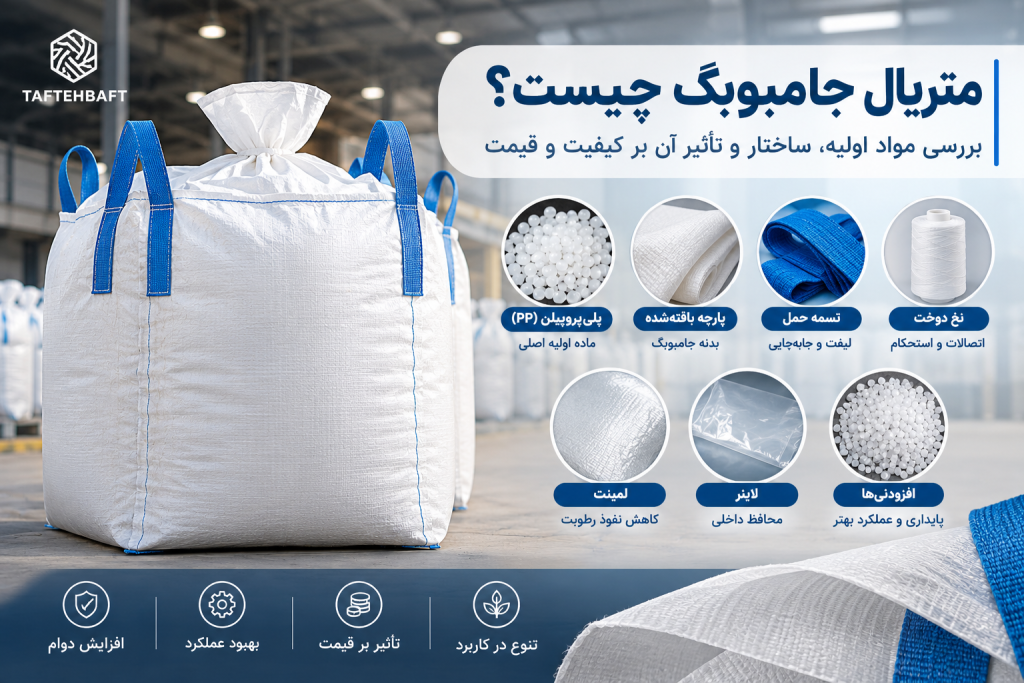
The main materials and components used in jumbo bag manufacturing include:
- Polypropylene (PP) for woven fabric and many lifting loops
- Sewing thread for joining the bag components
- Lifting loops and webbing for handling
- Lamination to improve surface protection and reduce fine-particle leakage
- Inner liners to provide an additional barrier
- Reinforcement materials and accessories suited to the bag design
The appropriate material combination depends on the required load capacity, packaged product, handling method, and operating environment.
1. Polypropylene (PP): The Main jumbo bag raw materials
Polypropylene is a widely used thermoplastic polymer and the primary material in many industrial jumbo bags. It is processed into yarn and woven fabric used to manufacture the bag body.
Why Is Polypropylene Used in Jumbo Bag Manufacturing?
Polypropylene is commonly selected for several reasons:
- Relatively low weight
- Suitability for producing woven tapes and yarns
- Good resistance to many common chemicals under suitable conditions
- Flexibility in fabric weight and product design
- Efficient large-scale manufacturing
- Compatibility with selected additives for specific applications
By selecting an appropriate PP grade and controlling the production process, manufacturers can produce yarn with properties suited to jumbo bag fabric.
Is Every Polypropylene Grade Suitable for Jumbo Bags?
No. The selected grade must be compatible with the manufacturing process and the required mechanical properties.
Melt flow rate (MFR or MFI), mechanical performance, raw material consistency, and additives may all be relevant when selecting a suitable grade.
A polymer grade that works well in one extrusion process is not necessarily the best choice for every jumbo bag application.
Recycled polypropylene can also be used in certain applications, but its quality and consistency must be controlled. The finished bag should meet the performance requirements of its intended use.
2. Woven Polypropylene Fabric: The Main Bag Body
After the raw material is processed into yarn or tapes, these elements are woven into fabric. The fabric forms the main body of the jumbo bag.
Fabric quality is a key factor in determining tensile performance, tear resistance, and the bag’s behavior during lifting and handling.
What Is Jumbo Bag Fabric GSM?
GSM stands for grams per square meter. It indicates the weight of one square meter of fabric and is an important specification in jumbo bag manufacturing.
However, GSM alone cannot determine the strength of a bag. Yarn quality, weave construction, mechanical properties, bag design, and stitching also affect performance.
Two fabrics with the same GSM may have different mechanical characteristics. Buyers should therefore evaluate the complete fabric specification rather than relying on weight alone.
How Does Weave Density Affect Performance?
Weave density refers to the number of warp and weft yarns within a specified length of fabric.
Together with yarn quality and fabric construction, weave density affects mechanical performance and the size of openings between the woven strands.
The fabric should be selected according to the product’s weight, handling conditions, and packaging requirements.
The Importance of Fabric Quality
Consistent weaving can help distribute forces throughout the fabric. Defects, inconsistent yarn quality, or uncontrolled variations in fabric specifications may compromise the bag’s performance.
For this reason, fabric inspection and manufacturing quality control are essential.
3. What Materials Are Used for Jumbo Bag Lifting Loops?
Lifting loops are critical components because they transfer the forces generated during lifting from the handling equipment to the bag structure.
Jumbo bag loops are commonly manufactured from polypropylene webbing. Their specifications must be appropriate for the bag design and rated load.
Important Properties of Lifting Loops
When selecting lifting loops, manufacturers and buyers should consider:
- Tensile strength
- Width and thickness
- Yarn quality and weaving construction
- Attachment method
- Number and positioning of loops
- Compatibility with lifting equipment
Strong webbing alone does not guarantee the safety of the complete bag. Stitching, attachment points, load distribution, and the bag’s rated capacity must also be evaluated.
Why Are Loop Attachments Important?
During lifting, forces travel from the loops through their attachment points and into the bag body. Poor attachment design or inadequate stitching can compromise the complete lifting system.
The loops, seams, and bag body should therefore be assessed as an integrated structure.
4. Sewing Thread Used in Jumbo Bags
Sewing thread joins fabric panels, secures accessories, and creates the finished bag structure.
Industrial jumbo bags may use polypropylene, polyester, or other suitable sewing threads depending on the design and manufacturing requirements.
Properties of Suitable Sewing Thread
Thread selection should consider tensile strength, consistency, abrasion resistance, and compatibility with the sewing equipment.
The final seam performance also depends on stitch type, stitch density, sewing quality, and joint design.
For heavy-duty jumbo bags, seams connecting the body and lifting loops deserve particular attention because these areas transfer significant forces during handling.
5. What Is Jumbo Bag Lamination Made Of?
Lamination is a polymer coating applied to the surface of woven fabric to improve certain performance characteristics.
Depending on the product design, jumbo bags may use polypropylene-based coatings or other compatible polymer layers.
Benefits of Lamination
Lamination can provide several benefits:
- Reduced moisture penetration through the fabric surface
- Reduced leakage of fine particles through weave openings
- Improved resistance to dust entering through the fabric
- A modified surface suitable for specific packaging requirements
However, lamination alone does not make a jumbo bag completely waterproof. Seams, filling spouts, discharge openings, and other joints must also be considered.
When Should You Choose Laminated Jumbo Bags?
Laminated jumbo bags may be suitable for selected powders, polymer granules, and dry materials that require improved moisture resistance or reduced fine-particle leakage.
The final choice should be based on the product’s properties and its storage and transportation conditions.
6. Jumbo Bag Liners: An Additional Protective Layer
A jumbo bag liner is a separate layer placed inside the outer bag. Liners are commonly made from polyethylene film or other suitable polymer structures.
The liner creates an additional barrier between the packaged product and the woven outer fabric. Depending on its design and closure system, it can help reduce moisture transfer and contamination.
Polyethylene (PE) for Jumbo Bag Liners
Polyethylene is widely used to manufacture plastic films. The appropriate PE type and film thickness depend on the product, packaging conditions, and required barrier properties.
What Is the Difference Between Lamination and a Liner?
Lamination is applied to the fabric surface, whereas a liner is a separate internal layer.
Their functions are therefore different. A liner may be sufficient for certain applications, while others may benefit from combining an inner liner with laminated outer fabric.
For more details, see our related article, “What Is a Jumbo Bag Liner? Types of PE Liners and Their Applications.”
7. Additives and Stabilizers Used in Jumbo Bag Manufacturing
Depending on the polymer and manufacturing process, additives may be used to improve specific material characteristics.
UV Stabilizers
Jumbo bags stored outdoors may be exposed to ultraviolet radiation. Prolonged UV exposure can degrade certain polymers and reduce their performance.
Suitable UV stabilizers can help improve resistance to this type of degradation. The required protection depends on the intensity and duration of sunlight exposure.
Color Masterbatch
Color masterbatch may be added when jumbo bags need to be manufactured in different colors. The masterbatch must be compatible with the base polymer and the production process.
Processing Additives
Certain additives can support manufacturing or help adjust specific material properties. Their selection should be based on technical requirements and compatibility with the finished product.
The presence of an additive does not automatically guarantee a particular performance level. Product specifications and appropriate testing remain important.
8. Virgin vs. Recycled Polypropylene for Jumbo Bags
The choice between virgin and recycled polypropylene is an important consideration in jumbo bag manufacturing.
Virgin Polypropylene
Virgin polypropylene is produced from polymer feedstocks through petrochemical manufacturing processes. Selecting a suitable, controlled grade can help provide consistent material properties.
Recycled Polypropylene
Recycled polypropylene is recovered and processed from used polymer products or manufacturing waste.
Its quality depends on the source material, contamination levels, recycling process, and quality control.
Recycled materials may differ from virgin materials in mechanical properties, consistency, and processing behavior. However, recycled content does not automatically make a product unsuitable. The material and finished bag should be evaluated against the intended performance requirements.
Which jumbo bag raw materials Is Better?
The answer depends on the application. For jumbo bags that must meet specific load and safety requirements, verified performance of the finished product is more important than whether the polymer is virgin or recycled.
For food-related applications, sensitive products, or specialized operating conditions, material compatibility and the required documentation should be checked separately.
9. How Do Jumbo Bag Materials Affect Price?
The price of a jumbo bag depends on more than the amount of polypropylene used. The specifications of all components and the manufacturing process influence the final cost.
jumbo bag raw materials Grade
The price and properties of the selected polypropylene grade can affect yarn production costs and the performance required from the finished bag.
Fabric Weight and Dimensions
Larger bags and heavier fabric specifications may require more raw material, increasing production costs.
Lifting Loops and Sewing Thread
Loop specifications, material consumption, thread type, and stitching complexity can all influence the manufacturing price.
Lamination and Inner Liners
Adding a laminated coating or an inner liner may increase production costs. However, these features can be worthwhile when additional protection is necessary to reduce product damage.
Bag Capacity and Design
Load capacity, top and bottom construction, number of loops, filling and discharge options, and customized features all affect the final price.
Order Quantity
Order volume and production specifications can influence the unit cost.
For an accurate comparison, buyers should provide the same technical specifications to each supplier. Comparing prices without matching specifications may lead to misleading conclusions.
10. How to Choose the Right Jumbo Bag Material
Before ordering jumbo bags, consider the following factors:
- Identify the product: Determine whether it is a powder, granule, mineral, agricultural product, or chemical.
- Confirm the load: Establish the actual weight the bag must carry.
- Assess the environment: Determine whether the bag will be stored indoors or outdoors.
- Evaluate moisture protection: Decide whether standard fabric is sufficient or whether lamination or a liner is required.
- Review fabric specifications: Select appropriate GSM, yarn quality, and weave construction.
- Inspect loops and seams: Ensure that the lifting components and joints are suitable for the bag design.
- Check special requirements: Chemical compatibility, food-contact suitability, and other requirements may need separate verification.
- Request technical documentation: Where necessary, ask for relevant specifications and performance test results.
The right material is one that meets the product’s actual requirements and performs reliably under its intended conditions.
Conclusion
Jumbo bag material includes all the raw materials and components used to manufacture the bag. Polypropylene, woven fabric, lifting loops, sewing thread, lamination, and inner liners are among the most important elements.
The quality of these materials, combined with bag design, manufacturing methods, and quality control, influences strength, durability, safety, and price.
When purchasing jumbo bags, buyers should look beyond the unit price and assess the technical specifications and required performance. Choosing materials suited to the packaged product and handling conditions can help reduce packaging-related losses and improve operational reliability.
Frequently Asked Questions About Jumbo Bag Materials
What is the main material used in jumbo bags?
Polypropylene (PP) is the main material used in many industrial jumbo bags. It is processed into yarn and woven fabric for the bag body.
Are all jumbo bag components made from polypropylene?
No. The body and many lifting loops are made from polypropylene, but sewing thread, liners, and other components may use different suitable polymers.
Why is fabric GSM important?
GSM indicates the weight of one square meter of fabric. It is an important specification, but yarn quality, weave construction, and bag design must also be evaluated.
Can recycled materials be used in jumbo bags?
Yes, in suitable applications. Their quality and consistency must be controlled, and the finished bag must meet the requirements of its intended use.
What is the difference between lamination and a liner?
Lamination is a coating applied to the fabric surface, while a liner is a separate layer placed inside the bag. They provide different types of protection.
Which material is suitable for heavy-duty jumbo bags?
The appropriate materials depend on the required load, bag design, rated capacity, lifting loops, seams, and verified performance of the finished product.