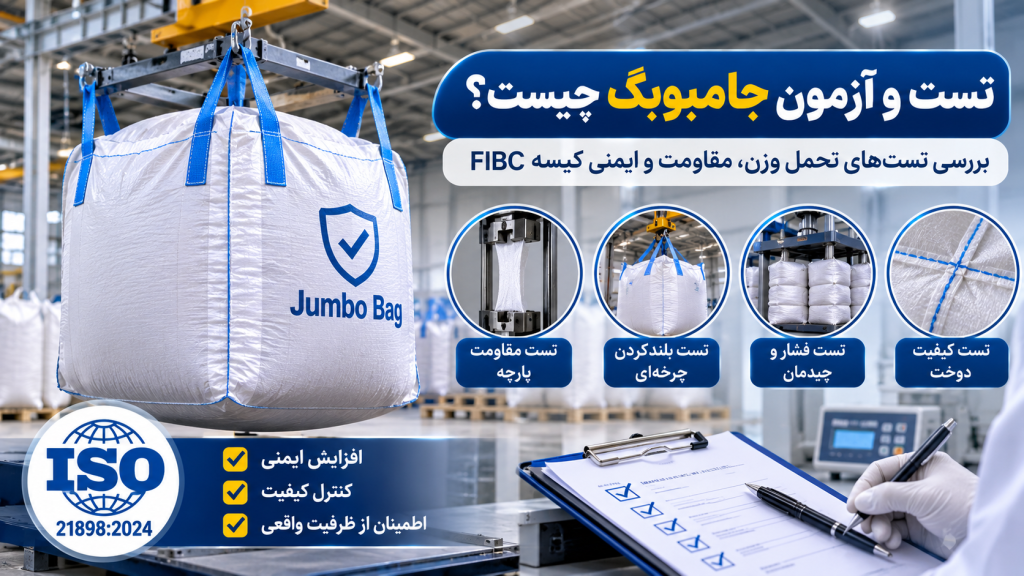
Jumbo bags, also known as FIBCs (Flexible Intermediate Bulk Containers), are widely used for storing and transporting bulk materials across industries such as chemicals, petrochemicals, agriculture, construction, mining and plastics. Jumbo bag testing refers to a series of technical tests and quality inspections used to evaluate the strength, durability and safe performance of an FIBC during filling, lifting, storage and transportation.
These large-capacity bags are designed to carry hundreds or even thousands of kilograms of material. Their safety and performance therefore depend on more than just fabric thickness or appearance. The strength of the fabric, stitching, lifting loops, seams and overall design must be suitable for the intended load and handling conditions.
This guide explains the main FIBC tests, relevant standards and the technical points buyers should check before purchasing jumbo bags.
What Is Jumbo Bag Testing and Why Is It Important?
Jumbo bag testing is the process of assessing whether an FIBC can safely carry its specified load and withstand the stresses associated with handling, lifting and storage.
Testing helps manufacturers and buyers evaluate several important performance characteristics:
- Load-bearing capacity and structural strength
- Resistance of fabric and seams to mechanical stress
- Strength of lifting loops and attachment points
- Performance during lifting and stacking
- Prevention of product leakage
- Suitability for the intended storage and transport conditions
Testing is important because two jumbo bags with the same nominal capacity may perform differently due to variations in material quality, construction, stitching and design.
ISO 21898:2024 – The Key FIBC Standard
One of the main international standards for FIBCs is ISO 21898:2024, titled Packaging — Flexible intermediate bulk containers (FIBCs) for non-dangerous goods.
This standard specifies requirements for materials, construction, design, type testing and marking of FIBCs intended for non-dangerous solid materials in powder, granular or paste form. It also provides guidance on selecting and safely using these containers.
The two principal performance tests specified for FIBC type testing are:
- Cyclic top lift test
- Compression/stacking test
It is important to understand that ISO 21898 applies to FIBCs for non-dangerous goods. Applications involving dangerous goods or potentially explosive atmospheres may require additional regulations and specialized standards.
1. Jumbo Bag Load Capacity Test
Load capacity is one of the first specifications to consider when selecting a jumbo bag.
The maximum load that an FIBC is certified to carry in service is called its Safe Working Load (SWL).
Common nominal capacities include:
- 500 kg
- 1,000 kg
- 1,250 kg
- 1,500 kg
- 2,000 kg
These are examples of commonly used capacities, not a guarantee that every bag design can safely carry these loads. The appropriate SWL must be established for the specific bag design.
What Does SWL Mean?
SWL stands for Safe Working Load. It is the maximum load that an FIBC is permitted to carry during normal service, as certified for that bag type.
For example, if a jumbo bag is marked with an SWL of 1,000 kg, this is its maximum permitted working load. It must not be exceeded during normal use.
SWL vs. Test Load
SWL should not be confused with the load applied during a performance test.
A test may expose a bag to a load higher than its SWL under controlled laboratory conditions. This is done to assess the design’s safety performance. It does not mean that the bag can be used above its certified SWL.
2. Cyclic Top Lift Test
The cyclic top lift test is one of the main performance tests for FIBCs.
In this test, a filled bag is lifted from its designated lifting devices according to a specified test procedure. The purpose is to evaluate the bag’s structural integrity under repeated lifting conditions.
The test examines:
- Strength of lifting loops
- Strength of loop attachment points
- Fabric performance under load
- Stitching and seam integrity
- Overall body condition
- Product retention
- Inner liner behavior, where applicable
Why Are Lifting Loops Important?
Lifting loops support the weight of the filled bag during handling. Their material, construction and attachment to the body must be suitable for the bag’s intended capacity.
Weak webbing or poor stitching can lead to loop failure and create serious handling hazards.
Main Acceptance Criteria
Under ISO 21898:2024, the lifting devices must not fail to the extent that they stop supporting their loads. The test must also not result in product loss or deterioration of the bag body that makes the FIBC unsafe for transport or storage.
Where an inner liner is fitted, it must not protrude beyond the outer surface of the bag, except where this is part of the intended closure design.
3. Compression and Stacking Test
FIBCs are often stored in warehouses or industrial facilities in stacked arrangements. Bags at the bottom of a stack may be subjected to considerable pressure from the bags above them.
The compression/stacking test evaluates whether an FIBC can withstand the specified compressive load without becoming unsafe.
The test focuses on:
- Structural stability under compression
- Fabric and seam integrity
- Prevention of product loss
- Resistance to deformation that could compromise safe storage
- Overall condition of the bag after testing
Why Is Stacking Performance Important?
Not every jumbo bag is suitable for stacking. The permitted stacking arrangement must be based on the bag’s design, test results and handling instructions.
Buyers should check the manufacturer’s specifications rather than deciding the stacking height based only on the bag’s appearance or nominal capacity.
4. Fabric Strength Testing
Most conventional FIBCs are manufactured from woven polypropylene (PP) fabric. The fabric’s mechanical properties are essential to the performance of the finished bag.
Several laboratory tests can be used to assess fabric quality.
Tensile Strength Test
A fabric specimen is placed in a tensile testing machine and pulled until it reaches a specified endpoint or breaks.
The test can measure:
- Maximum tensile force
- Elongation at maximum force
- Fabric behavior under increasing tension
- Differences between warp and weft directions
Tear Resistance Test
This test evaluates how well the fabric resists the propagation of an existing tear.
Tear resistance is important because a small cut or damaged area can expand when the bag is filled or lifted.
Weave and Fabric Quality Inspection
Visual and technical inspections may assess:
- Weave consistency
- Fabric uniformity
- Tape condition
- Visible defects
- Fabric weight and construction
Fabric weight or thickness alone does not prove that an FIBC is safe. The entire bag design, including its seams and lifting devices, must be considered.
5. Jumbo Bag Stitching Strength Test
Stitching is a critical part of FIBC construction. Even high-quality fabric can fail if the seams or connections are poorly designed or manufactured.
Important areas to inspect include:
- Bottom seams
- Side seams
- Lifting loop attachments
- Filling spout connections
- Discharge spout connections
- Inner liner seams, where applicable
Factors Affecting Stitching Strength
Stitching performance depends on several factors:
- Thread material and quality
- Stitch type and density
- Sewing machine settings
- Fabric thickness and construction
- Operator skill and production consistency
- Design of the connection between components
Representative seam samples can be tested to determine the force required to cause failure. However, a seam test alone cannot replace performance testing of the complete FIBC.
6. UV Resistance Test
Jumbo bags stored outdoors may be exposed to sunlight for extended periods. Ultraviolet radiation can gradually degrade polypropylene and reduce the mechanical strength of the fabric.
UV resistance is particularly important for FIBCs used in open storage areas, ports, construction sites and outdoor industrial facilities.
How Is UV Resistance Evaluated?
Fabric specimens are exposed to controlled ultraviolet radiation under specified laboratory conditions.
After exposure, their mechanical properties can be compared with those of unexposed specimens to assess the degree of degradation.
UV performance depends on the polymer, stabilizing additives, exposure conditions and duration of sunlight exposure.
A UV-resistant label alone is not sufficient evidence of performance. The test method and supporting results should be available.
7. Inner Liner Testing
Some FIBCs include an inner polyethylene (PE) liner to provide an additional barrier between the contents and the outer woven fabric.
Liners are commonly considered for moisture-sensitive products, fine powders and materials that require additional containment.
Quality inspections may include:
- Film thickness and uniformity
- Pinholes, tears or visible defects
- Sealing and attachment quality
- Filling and discharge area performance
- Resistance to puncture or mechanical damage
- Compatibility with the packaged product
An inner liner does not automatically make a jumbo bag completely waterproof. The closure system, filling and discharge openings, and overall design must also be considered.
8. Leakage Inspection
Leakage can cause product loss, contamination and additional handling costs, particularly when FIBCs are used for fine powders or small granules.
Quality inspections may focus on:
- Holes or tears in the fabric
- Stitching defects
- Filling and discharge closures
- Inner liner integrity
- Potential leakage points around seams and openings
The inspection method should be selected according to the particle size and properties of the packaged material.
9. FIBC Safety Factor
The safety factor (SF) is an important technical characteristic of a jumbo bag.
Under ISO 21898:2024, the safety factor is defined using the final load achieved in the cyclic top lift test divided by the SWL, with the resulting quotient rounded down to an integer.
For example, consider an FIBC with an SWL of 500 kg:
- If the final test load is 2,400 kg, the quotient is 4.8 and the safety factor is 4.
- If the final test load is 2,600 kg, the quotient is 5.2 and the safety factor is 5.
These examples illustrate the calculation method. The required safety factor depends on the applicable standard requirements and the intended FIBC category.
What Is the Difference Between 5:1 and 6:1?
These ratios describe the relationship between the test load and the safe working load. They are often used in FIBC specifications, but the appropriate requirement depends on the bag’s design and intended use.
A higher safety factor does not authorize the user to exceed the SWL marked on the bag.
10. FIBC Labels and Test Information
The label provides important information for identifying the bag and checking its specifications.
Depending on the applicable requirements, the marking may include:
- Manufacturer’s name and address
- FIBC type identification
- Safe Working Load (SWL)
- Safety Factor (SF)
- Permitted stacking information
- Test reference and identification details
- Testing organization
- Relevant standard
- Single-trip or reusable classification
- Production and traceability information
A label mentioning an international standard does not, by itself, prove that the product conforms to that standard. Buyers should request relevant test reports and conformity documentation for the specific FIBC type.
11. Why Do Jumbo Bags Fail Tests?
An FIBC may fail a test for several reasons, including:
Poor Fabric Quality
Unsuitable raw materials, inconsistent weaving or insufficient fabric strength can reduce the bag’s load-bearing performance.
Weak Stitching
Poor seam construction or inadequate thread strength may cause seams to open under load.
Defective Lifting Loops
Weak webbing or poor loop attachments can compromise lifting safety.
Incorrect Capacity Selection
A bag designed for a different load or product may not perform safely in the intended application.
Poor Inner Liner Quality
Punctures, weak seals or unsuitable liner design can lead to leakage or damage.
Inadequate Overall Design
Even when individual components appear acceptable, an unsuitable combination of materials, dimensions and construction can result in poor performance.
12. Quality Control vs. Standard FIBC Testing
Quality control and standard type testing are related, but they are not the same.
The Quality control (QC) includes inspections and tests carried out during production to check raw materials, components and finished products.
Type testing evaluates a specific FIBC design against the performance requirements of an applicable standard.
| Feature | Production Quality Control | Standard Type Testing |
|---|---|---|
| Main purpose | Maintain production quality | Evaluate design performance |
| Timing | Throughout production | For a defined FIBC type |
| Samples | Materials, components and finished bags | Representative FIBC specimens |
| Test scope | Manufacturer’s QC program | Standardized test procedures |
| Outcome | Identify and correct defects | Assess conformity with requirements |
For example, testing the tensile strength of polypropylene fabric may be part of a manufacturer’s quality control program. It does not replace the cyclic top lift and compression/stacking tests required for FIBC type testing under ISO 21898.
13. What Should Buyers Check Before Purchasing Jumbo Bags?
Before ordering FIBCs for industrial or export applications, buyers should review more than the price and appearance of the bag.
Important points include:
- Safe Working Load: Is the SWL suitable for the actual product weight?
- Bag design: Is it intended for single-trip or reusable service?
- Safety Factor: Does it meet the requirements of the intended application?
- Test documentation: Are relevant test reports available for the same FIBC type?
- Fabric specifications: Are the material and construction suitable?
- Stitching and lifting loops: Are the seams and lifting devices properly designed?
- Stacking requirements: Is the bag approved for the intended storage arrangement?
- Environmental conditions: Is UV protection or an inner liner required?
- Product marking: Are the technical details and manufacturer information traceable?
Buyers should also provide the manufacturer with details about the material, filling weight, dimensions, filling method, discharge method, transport conditions and storage requirements.
14. Why Does Choosing a Reliable Jumbo Bag Manufacturer Matter?
The performance of an FIBC depends on the complete manufacturing process, including raw material selection, fabric production, cutting, sewing, component assembly and quality inspection.
A reliable manufacturer should be able to explain the technical specifications of its products and provide relevant quality documentation.
When selecting a supplier, consider:
- Clear technical specifications
- Appropriate raw materials
- Consistent fabric and stitching quality
- Proper lifting loop design
- Different sizes and load capacities
- Relevant test reports and technical documents
- Production capacity and delivery reliability
Providing accurate application details before placing an order helps the manufacturer recommend a suitable FIBC design.
Conclusion
Jumbo bag testing is essential for evaluating the safety, strength and performance of FIBCs. Tests such as cyclic top lift and compression/stacking help assess whether a particular bag design can withstand the specified handling and storage conditions.
Fabric strength, seam quality, UV resistance and inner liner inspections can also support the manufacturer’s quality control program.
Before purchasing a jumbo bag, buyers should review the SWL, safety factor, design, marking and relevant test documentation. The right FIBC should be selected according to the product, load and actual conditions of use—not simply its appearance or price.
Frequently Asked Questions About Jumbo Bag Testing
1. What is jumbo bag testing?
Jumbo bag testing is a series of technical tests used to evaluate the strength, load capacity, durability and safety of an FIBC.
2. Which standard is used for FIBC testing?
ISO 21898:2024 is a key standard for FIBCs intended for non-dangerous goods. It specifies requirements for materials, construction, design, type testing and marking.
3. What does SWL mean on a jumbo bag?
SWL stands for Safe Working Load. It is the maximum certified load that the FIBC may carry during service.
4. How is the cyclic top lift test performed?
A filled FIBC is lifted through its designated lifting devices according to a specified procedure. The test evaluates the performance of the lifting loops, attachments and bag body.
5. What is the purpose of the compression/stacking test?
It evaluates whether the FIBC can withstand the specified compressive load associated with stacking and storage without becoming unsafe.
6. What is the difference between a 5:1 and 6:1 safety factor?
These values describe the relationship between the final test load and the SWL. The applicable requirement depends on the FIBC design and intended use.
7. Does every jumbo bag need to be individually tested?
Type testing evaluates a defined FIBC design. Manufacturers also use production quality control to inspect materials and finished products. This does not necessarily mean every bag is individually subjected to the full type-test procedure.
8. Can a 1,000 kg jumbo bag carry more than 1,000 kg?
No. A bag marked with an SWL of 1,000 kg must not be used above that certified working load, even if it withstands a higher load during a controlled laboratory test.
9. Do FIBCs with inner liners also require testing?
The liner and its interaction with the outer bag should be considered in the design and applicable tests. ISO 21898 includes requirements relating to liner behavior during the cyclic top lift test.
10. How can buyers check FIBC quality before purchasing?
Buyers should review the SWL, safety factor, technical specifications, product marking, manufacturing quality and relevant test reports for the specific FIBC type.