
Introduction
A Jumbo Bag, also known as an FIBC (Flexible Intermediate Bulk Container) or Bulk Bag, is widely used for storing, handling and transporting bulk materials in industries such as chemicals, petrochemicals, mining, agriculture, food processing and construction.
Most FIBC bags are manufactured from woven polypropylene (PP). During filling, discharging, transportation and handling, however, friction between the product and the inner surface of the bag can generate static electricity.
In ordinary environments, static electricity may simply cause a small electric shock or visible discharge. However, in areas containing flammable gases, vapours or combustible dust, an electrostatic discharge may become a potential ignition source.
This is why FIBC bags are classified according to their electrostatic properties.
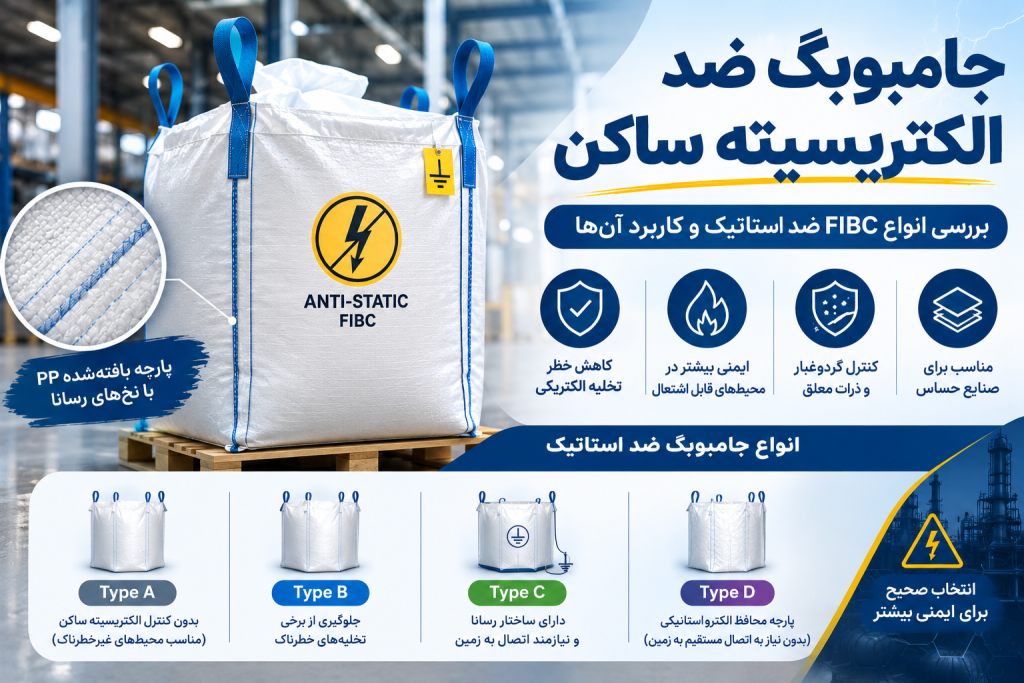
The standard IEC 61340-4-4 classifies FIBCs into four main electrostatic categories:
- Type A
- Type B
- Type C
- Type D
Each type has different characteristics and operating requirements.
In this guide, we explain what an anti-static jumbo bag is, how static electricity is generated, the differences between Type A, B, C and D FIBC bags, and how to select the right FIBC for a specific application.
What Is an Anti-Static Jumbo Bag?
An anti-static jumbo bag is an FIBC designed to control or reduce risks associated with the accumulation and discharge of static electricity.
During the movement of dry powders and granules, electrical charges can develop through contact and separation between different surfaces.
This can happen during:
- Filling
- Discharging
- Conveying
- Mixing
- Transportation
- Handling of powders
- Friction between the product and the FIBC fabric
Anti-static FIBC designs use specific materials, conductive components or electrostatic-protective fabrics to control these charges.
However, the term “anti-static” alone does not indicate that a jumbo bag is suitable for every hazardous environment.
The correct FIBC must be selected according to factors such as:
- FIBC type
- Product properties
- Minimum Ignition Energy (MIE)
- Presence of flammable gases or vapours
- Dust explosion hazards
- Filling and discharging methods
- Grounding requirements
- Liner configuration
Why Is Static Electricity Important in Jumbo Bags?
Static electricity is generated when different materials come into contact and then separate.
This can occur when dry powders or granules move through equipment or come into contact with the inner surface of an FIBC.
Static charges may develop during:
- Filling the jumbo bag
- Emptying the jumbo bag
- Pneumatic conveying
- Powder transfer
- Mechanical handling
- Product movement inside the bag
In a normal environment, the resulting discharge may not create a significant hazard.
However, if a flammable atmosphere is present, an electrostatic discharge can potentially provide an ignition source.
For this reason, electrostatic control is particularly important when FIBCs are used in chemical, pharmaceutical, petrochemical and other hazardous industrial environments.
Types of Anti-Static FIBC Bags
FIBCs are commonly classified into four main types according to their electrostatic characteristics:
- Type A
- Type B
- Type C
- Type D
These types have different construction methods and different requirements for controlling electrostatic discharge.
What Is a Type A FIBC?
Type A FIBC is the simplest category from an electrostatic-control perspective.
It is generally manufactured from standard insulating materials and does not include specific electrostatic-control measures.
Main characteristics of Type A:
- No special electrostatic-control system
- Generally intended for non-hazardous environments
- Not designed for hazardous explosive atmospheres
- Does not provide dedicated static dissipation
Type A should not automatically be considered an anti-static jumbo bag.
What Is a Type B FIBC?
Type B FIBC is designed to reduce the risk of certain dangerous electrostatic discharges.
It can be manufactured from insulating materials with controlled electrical properties that help prevent specific types of electrostatic discharge.
Type B does not rely on grounding the FIBC in the same way as Type C.
However, this does not mean that Type B is suitable for every flammable environment.
Its suitability depends on factors such as the material’s Minimum Ignition Energy and whether flammable gases or vapours are present.
What Is a Type C FIBC?
Type C FIBC, often called a Conductive FIBC, is manufactured using conductive fabric or conductive threads incorporated into the bag structure.
The key feature of Type C is that it must be properly connected to ground/earth during filling and discharging operations.
In simple terms:
Type C = Conductive structure + Ground connection
The grounding system provides a controlled path for electrical charges to dissipate.
Main characteristics of Type C:
- Conductive or electrostatically controlled construction
- Designed with grounding points
- Requires proper grounding during operation
- Used for applications where electrostatic control is critical
- Grounding continuity must be maintained
A Type C FIBC should not be used simply because it is labelled “conductive”; the grounding system and operating procedures are essential parts of its safe use.
What Is a Type D FIBC?
Type D FIBC uses specially designed electrostatic-protective fabric.
Unlike Type C, Type D does not rely on a direct connection between the FIBC and ground for its electrostatic protection.
In simple terms:
Type D = Electrostatic-protective fabric + No direct FIBC grounding requirement
Type D FIBCs are designed to control dangerous electrostatic discharges under specified conditions.
However, their suitability still depends on the material, environment and operating conditions.
Difference Between Type A, Type B, Type C and Type D FIBC
| FIBC Type | Electrostatic Control | Grounding | General Characteristics |
|---|---|---|---|
| Type A | None | No | General non-hazardous applications |
| Type B | Limited electrostatic control | Generally no | Controls certain dangerous discharges |
| Type C | Conductive | Required | Conductive FIBC requiring grounding |
| Type D | Electrostatic-protective fabric | Not directly required | Designed to control dangerous discharges without direct grounding |
This table provides a general overview. The correct FIBC must always be selected according to the applicable standard, product properties and risk assessment.
Type C vs Type D FIBC: What Is the Difference?
One of the most important questions when selecting an anti-static jumbo bag is the difference between Type C and Type D.
Type C
a Type C uses a conductive structure and requires a reliable grounding connection.
<strong>Type C = Conductive + Grounded
If the grounding connection is not correctly established, the expected electrostatic protection cannot be assumed.
Type D</h3>
a Type D uses specially engineered electrostatic-protective fabric and does not rely on direct grounding of the FIBC.
<strong>Type D = Electrostatic-protective fabric + No direct grounding
The choice between Type C and Type D should be based on the product, operating environment, risk assessment and applicable technical requirements.
Are Anti-Static Jumbo Bags Suitable for Flammable Materials?
The answer depends on the FIBC type and operating conditions.
Simply labelling a product as “Anti-Static” does not automatically mean that it is suitable for every flammable powder, gas or vapour.
Important factors include:
- Minimum Ignition Energy (MIE)
- Dust characteristics
- Presence of flammable gases
- Presence of flammable vapours
- Filling method
- Discharging method
- Material flow rate
- FIBC type
- Liner design
- Grounding system
- Environmental conditions
Therefore, selecting an FIBC for hazardous applications should be part of a proper technical risk assessment.
What Is Minimum Ignition Energy (MIE)?
Minimum Ignition Energy (MIE) refers to the lowest energy under specified test conditions that can ignite a combustible material.
MIE is an important parameter when assessing the electrostatic hazards associated with powders and dusts.
Materials with low ignition energy require greater control of potential ignition sources.
Therefore, the selection of Type B, Type C or Type D FIBC should not be made without considering the characteristics of the material being handled.
Applications of Anti-Static Jumbo Bags
Anti-static FIBC bags can be used in a wide range of industrial applications.
Petrochemical Industry
Petrochemical facilities may handle powders, granules and other materials in areas where flammable gases or vapours can be present.
Proper electrostatic control can therefore be an important part of the overall safety system.
Chemical Industry
Many dry chemical powders can generate electrostatic charges during transportation and handling.
Anti-static FIBCs can be used where their specific electrostatic characteristics are compatible with the material and operating environment.
Mining and Mineral Processing
Fine mineral powders and industrial materials may generate static charges during filling and transportation.
The appropriate FIBC type should be selected according to the material properties and operating conditions.
Food Industry
Some dry food powders and fine particles may also require electrostatic control.
However:
Anti-static does not mean Food Grade.
If the FIBC comes into direct contact with food, the materials, manufacturing process, hygiene requirements and applicable food-contact regulations must also be considered.
Does a Type C Jumbo Bag Need Grounding?
Yes.
One of the defining characteristics of Type C FIBC is the requirement for proper grounding during filling and discharging.
The bag normally includes a designated grounding point for connection to an appropriate grounding system.
Simply relying on accidental contact between lifting equipment and the bag is not an appropriate substitute for a designated grounding connection.
Grounding continuity should also be maintained during the relevant operation.
Is Type D Better Than Type C?
There is no universal answer that Type D is better than Type C.
The two systems use different approaches to electrostatic control.
Type C relies on a conductive structure and grounding.
Type D uses electrostatic-protective fabric and does not rely on direct grounding of the FIBC.
The appropriate choice depends on:
- Product properties
- Ignition characteristics
- Working environment
- Equipment
- Filling process
- Discharging process
- Safety procedures
- Applicable standards
decision should therefore be based on a proper engineering risk assessment rather than a simple comparison.
The Role of FIBC Liners in Anti-Static Jumbo Bags
A PE liner can affect the electrostatic behaviour of an FIBC.
For this reason, any liner used inside an anti-static FIBC must be compatible with the specific FIBC design and application.
Not every PE liner is automatically suitable for every Type C or Type D bag.
The compatibility of the FIBC and inner liner should therefore be evaluated, especially in hazardous applications.
Can a Laminated Jumbo Bag Be Anti-Static?
Yes, but lamination by itself does not make an FIBC anti-static.
Lamination can provide benefits such as:
- Improved moisture resistance
- Reduced dust penetration
- Better product protection
- Reduced permeability
Electrostatic control is a separate property.
Therefore:
Laminated ≠ Anti-Static
An FIBC can be both laminated and electrostatically controlled, but these are two different design characteristics.
How Are Anti-Static FIBCs Tested?
Electrostatic testing of FIBC bags can include different electrical and performance tests depending on the FIBC type.
These may involve:
- Electrical resistance
- Resistance to ground
- Breakdown voltage
- Electrostatic discharge characteristics
- Surface properties
- Liner characteristics
- Functional performance
The exact tests depend on the FIBC classification and intended application.
For industrial applications, manufacturers should provide appropriate technical specifications and test documentation.
Anti-Static Jumbo Bag Labelling
Labelling is important because it helps identify the FIBC classification and its intended operating conditions.
When purchasing an anti-static jumbo bag, it is therefore not enough to rely only on terms such as:
“Anti-Static”
The buyer should verify:
- FIBC type
- Applicable standard
- Technical specifications
- Test documentation
- Grounding requirements
- Liner specifications
- Intended application
What Should You Consider When Buying an Anti-Static Jumbo Bag?
Before purchasing an anti-static FIBC, consider the following:
1. FIBC Type
Determine whether you require Type B, Type C or Type D.
2. Product Characteristics
Identify the physical and electrical characteristics of the material.
3. Minimum Ignition Energy
For combustible powders, MIE can be an important parameter.
4. Operating Environment
Determine whether flammable dust, gases or vapours are present.
5. Filling Method
The filling process can affect electrostatic charge generation.
6. Discharging Method
The discharge process should also be considered during FIBC selection.
7. Liner
If a PE liner is required, confirm its compatibility with the selected FIBC type.
8. Grounding
For Type C FIBC, a suitable grounding system is essential.
9. Test Documentation
Request technical specifications and relevant test reports from the manufacturer.
Difference Between Standard and Anti-Static Jumbo Bags
| Feature | Standard Jumbo Bag | Anti-Static Jumbo Bag |
|---|---|---|
| Static control | Limited or none | Designed for electrostatic control |
| Conductive components | Usually absent | May be incorporated |
| Grounding | Generally not applicable | Required for Type C |
| Type A | Yes | No |
| Type B | No | Yes |
| Type C | No | Yes |
| Type D | No | Yes |
The term anti-static jumbo bag is a general description, so the exact FIBC classification should always be verified.
Are Anti-Static Jumbo Bags Suitable for Powders?
Depending on the FIBC type and operating conditions, anti-static jumbo bags can be used for various dry powders and fine materials, including:
- Chemical powders
- Mineral powders
- Petrochemical materials
- Industrial powders
- Fine particles
- Some dry food ingredients
- Materials sensitive to electrostatic discharge
The final selection must be based on the properties of the actual product and the working environment.
Can Anti-Static Jumbo Bags Be Used for Cement?
There is no universal requirement stating that every cement jumbo bag must be anti-static.
The decision depends on the actual process and environment, including:
- Cement type
- Filling speed
- Transfer equipment
- Dust concentration
- Surrounding environment
- Presence of flammable materials
- Discharging method
Where an electrostatic hazard exists, the appropriate FIBC classification should be selected as part of the safety assessment.
Anti-Static Jumbo Bags in the Petrochemical Industry
The petrochemical industry is one of the sectors where ignition-source control can be particularly important.
Powders and granules may be transported in environments where flammable gases or vapours are present.
Using an unsuitable FIBC in such conditions can create safety concerns.
Therefore, the FIBC type, product characteristics, grounding arrangements, operating procedures and hazardous-area requirements should all be evaluated together.
Does FIBC Capacity Determine Its Electrostatic Type?
No.
The weight capacity of a jumbo bag does not determine its electrostatic classification.
For example, two FIBC bags may both have a capacity of 1,000 kg, while one is Type A and the other is Type C.
Likewise, two 1,500 kg jumbo bags may require completely different electrostatic properties depending on the materials they contain.
Therefore:
Jumbo Bag Capacity ≠ Electrostatic Classification
How to Choose the Right Anti-Static Jumbo Bag
Follow these steps when selecting an anti-static FIBC:
Step 1: Identify the Product
Determine exactly what material will be packed inside the jumbo bag.
Step 2: Assess Electrostatic Risk
Determine whether the material can generate electrostatic charges during handling.
Step 3: Check MIE
For combustible materials, obtain information about Minimum Ignition Energy.
Step 4: Evaluate the Environment
Check for combustible dust, flammable gases or vapours.
Step 5: Select the FIBC Type
Choose the appropriate FIBC classification based on the risk assessment.
Step 6: Evaluate the Liner
If an inner liner is required, verify compatibility with the selected FIBC.
Step 7: Check Grounding Requirements
For Type C FIBC, ensure that a reliable grounding system is available.
Step 8: Request Documentation
Obtain technical specifications, classification information and relevant test documentation from the manufacturer.
Frequently Asked Questions About Anti-Static Jumbo Bags
What is an anti-static jumbo bag?
An anti-static jumbo bag is an FIBC designed to control or reduce risks associated with static electricity accumulation and electrostatic discharge.
What are the main types of anti-static FIBC?
FIBCs are classified into four main types according to their electrostatic characteristics: Type A, Type B, Type C and Type D.
What is a Type C FIBC?
Type C is a conductive FIBC that requires proper grounding during relevant filling and discharging operations.
What is a Type D FIBC?
Type D uses electrostatic-protective fabric and does not rely on direct grounding of the FIBC for its electrostatic protection.
What is the difference between Type C and Type D?
Type C relies on a conductive structure and grounding, while Type D uses electrostatic-protective fabric without relying on direct grounding of the FIBC.
Is Type D always better than Type C?
No. The appropriate choice depends on the material, environment, equipment, operating conditions and risk assessment.
Is a laminated jumbo bag anti-static?
Not necessarily. Lamination and electrostatic control are separate properties.
Can anti-static FIBC bags be used for flammable materials?
They may be suitable for certain applications, but the FIBC type, material properties, MIE, environment and operating conditions must be evaluated before selection.
Conclusion
An anti-static jumbo bag is an FIBC designed to control electrostatic charges and reduce the risks associated with electrostatic discharge in suitable applications.
The four main FIBC classifications are:
- Type A: No specific electrostatic-control measures
- Type B: Designed to prevent certain dangerous discharges
- Type C: Conductive FIBC requiring grounding
- Type D: Electrostatic-protective FIBC that does not rely on direct grounding
Selecting an anti-static FIBC should never be based solely on the term “Anti-Static.”
The product characteristics, Minimum Ignition Energy, operating environment, filling and discharging methods, liner configuration and grounding requirements should all be considered.
For demanding industrial applications, the most appropriate approach is to select the FIBC as part of a documented technical and safety risk assessment.